Every family has a Grandma Pam
History remembers those who changed the world. Family photographs remember those who changed us.
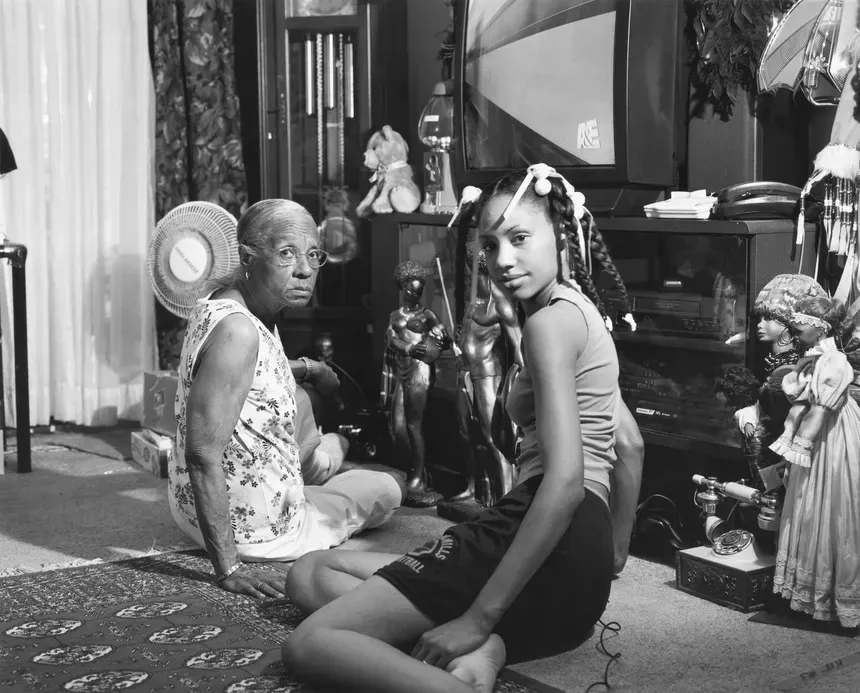
LaToya Ruby Frazier's Grandma Ruby and Me (2005) is, in many respects, an ordinary family photograph. Grandma Ruby sits on the living room floor, looking directly towards the camera. Beside her, a young Frazier turns to meet our gaze. Around them are the familiar details of domestic life: a television, a standing fan, porcelain figurines, patterned carpet and furniture gathered over decades. Nothing in the photograph announces itself as historically significant. There are no famous faces, no dramatic events and no obvious symbols of national importance. Yet it is precisely this ordinariness that gives the photograph its extraordinary power. Looking at it now, it becomes difficult to believe that anything within the frame could ever have been considered unremarkable.
Photography has often inherited its understanding of significance from history. Museums celebrate artists, politicians and activists. Newspapers elevate public figures. Documentary photographers have frequently sought people whose lives illuminate wider social or political questions. These are valuable traditions, but they are not the only traditions photography has produced. Public history asks who changed the world. Family photography asks who changed us. They are different ways of measuring significance.
That difference may seem small, but it produces an entirely different understanding of what deserves to be remembered. Open almost any family album and its pages are filled with faces that mean very little beyond the family itself. A grandmother sitting in her favourite chair. An uncle proudly standing beside his first new car. A cousin on graduation day. An aunt behind the counter of the business she built. Their names are unlikely to appear in museum catalogues or history books, yet remove them from the family's story and the generations that follow become difficult to explain. Their importance has never depended upon public recognition because it was established long before anyone beyond the family knew they existed.
Pete Rock and C.L. Smooth captured this beautifully in T.R.O.Y. (They Reminisce Over You). Rather than introducing listeners to celebrities or public figures, C.L. Smooth names the people who formed the architecture of his own life. Grandmom Pam holds the family together. Uncle Doc is admired. Uncle Sterling always has the latest car. Aunt Joyce runs her own business. To anyone outside the family these names are anonymous, yet almost everyone recognises the roles they occupy. The details are culturally specific, but the structure is universal. Every family has its own Grandmom Pam, its own Aunt Joyce, its own relative whose quiet example became the standard by which later generations came to understand generosity, ambition or resilience.
The verse reveals something that photography has long understood, even if its institutions have not always acknowledged it. Influence is not always public. Some of the people who shape our lives most profoundly never become visible beyond the communities that know them. A grandmother who quietly holds a family together may never become historically significant in the conventional sense. An aunt who runs a small business may never appear in the pages of a newspaper. A neighbour who mentors generations of local children may never receive public recognition. Yet remove them from the story of a family and that family's history begins to lose its coherence. Their influence was never measured by the number of people who knew their names, but by the depth of the lives they touched.
Seen in this light, Grandma Ruby and Me becomes more than a portrait. A visitor encountering the photograph in a gallery sees an acclaimed work by one of the most important photographers of her generation. But before it entered museums, books and exhibitions, it belonged to a family. Before it became part of photographic history, it was already part of family history. Its significance did not begin when institutions recognised it. Photography did not create its importance. It simply made visible a relationship whose value already existed.
This distinction changes how we think about photographs themselves. Photography is often described as a medium of evidence, but evidence is never complete. A camera records appearances with remarkable precision, yet appearances alone rarely explain why a photograph continues to matter. Looking at Frazier's photograph, we can see Grandma Ruby's face, her posture and the room she inhabits. What we cannot see are the years of care, sacrifice, humour and reassurance that transformed her into the emotional centre of a family. Those qualities exist beyond the frame. They survive because memory continues to animate the photograph long after the shutter has been released.
That is perhaps the defining characteristic of family photographs. They do not simply preserve a moment; they accumulate meaning. The image itself remains unchanged, yet every birthday, funeral, reunion and passing year alters how it is read. A photograph that once seemed entirely ordinary slowly becomes irreplaceable because the lives surrounding it continue to unfold. As older generations disappear, the photograph begins to carry responsibilities it never held before. It becomes witness, evidence and inheritance all at once. The camera records a face, but time transforms that face into a history.
This is also why it is worth distinguishing between a family photograph and a family album. A photograph captures a moment. An album constructs a history. Families decide which photographs belong together, which occasions deserve repeating and which lives remain central to the story they tell about themselves. Albums are acts of editing as much as preservation. They sequence generations, establish relationships and quietly communicate what a family believes is worth carrying forward. Long before curators assembled exhibitions, families were already curating their own histories.
This becomes especially significant when considering the photographic history of Black life. Much of that history has reached us through institutions documenting moments of struggle, protest and political transformation. Those photographs remain indispensable. They preserve histories that might otherwise have been erased and continue to shape our understanding of the past. But they answer only one of photography's questions. Alongside them exists another archive assembled not by governments, newspapers or museums, but by families themselves. Its pages are filled with birthdays, weddings, graduations, church services, Sunday dinners, first homes and family reunions. These photographs were never waiting for institutional recognition because they were made according to a different understanding of significance.
This is one of the great contributions of Black family photography. It reminds us that photography has never possessed a single hierarchy of value. Different photographic traditions have always organised significance differently. Documentary photography often asks who shaped society. Family photographs ask who shaped the family that would eventually shape society. Neither question cancels the other. Together they reveal that photography has never spoken with a single voice about who matters.
This idea echoes a broader question explored elsewhere on theBLKGZE: whether photography has ever possessed a single way of seeing in the first place.
Seen again from this perspective, Frazier's photograph becomes both deeply personal and quietly philosophical. Grandma Ruby is not presented as a public figure or historical symbol. She appears first as herself: a grandmother, a matriarch and the person around whom a family's understanding of itself has been built. The photograph invites us to recognise that these identities are not somehow smaller than those celebrated by history. They simply belong to a different scale of significance. They remind us that history is ultimately composed of families, and that every public life begins within private relationships that photographs have long been preserving.
The mention of Aunt Joyce in T.R.O.Y. captures this beautifully. She is remembered not because she became famous, but because she expanded what seemed possible. Watching a relative run a business teaches lessons that no speech can communicate. Children inherit ambition long before they learn to describe it. They encounter possibility across the dinner table, during family gatherings and through photographs that quietly preserve the people whose lives became examples. Family albums do not simply preserve faces. They preserve models of adulthood, ways of caring for others and ideas about the kind of lives that can be built. They become repositories not only of memory but of imagination.
Perhaps this is why the photographs we value most are not always those that photography celebrates most publicly. A blurred snapshot may ultimately carry greater significance than an award-winning image if it is the only remaining photograph of the aunt whose encouragement changed the course of a family's future. The technical qualities of a photograph undoubtedly matter, but family albums remind us that relationships are often what determine a photograph's lasting value. Their importance lies not simply in what they show, but in what successive generations continue to discover within them.
Looking once more at Grandma Ruby and Me, it is tempting to see an important work by a celebrated artist, and it is certainly that. But the photograph asks something more fundamental of photography itself. It suggests that the medium has never operated according to a single philosophy of significance. Museums, newspapers, documentary photographers and families have each developed their own ways of deciding who deserves to be remembered. Photography has never possessed a single hierarchy of significance. Some ask who changed history. Others ask who changed a household, a neighbourhood or a single life. Photography is richer because it contains all of these traditions, not because one eventually triumphs over the others.
The enduring achievement of family photography is that it has always resisted the temptation to confuse fame with importance. Long before institutions decided which lives deserved public recognition, families had already answered that question for themselves. They understood that the people who shape a life are not always the people who shape a nation. In that sense, the family album does more than preserve the past. It reminds photography that there has never been only one way to measure a life, and never only one answer to the question of who matters.
Key idea
Family photographs ask a different question from history.
About Foundation Essays
This essay is part of theBLKGZE's Foundation series, which explores the ideas that shape photography, visual culture and the Black gaze.


