A photograph can outlive the person it photographs
A photograph can preserve someone's face with extraordinary precision while preserving very little of the life that face belonged to. What happens when the image becomes more recognisable than the person?
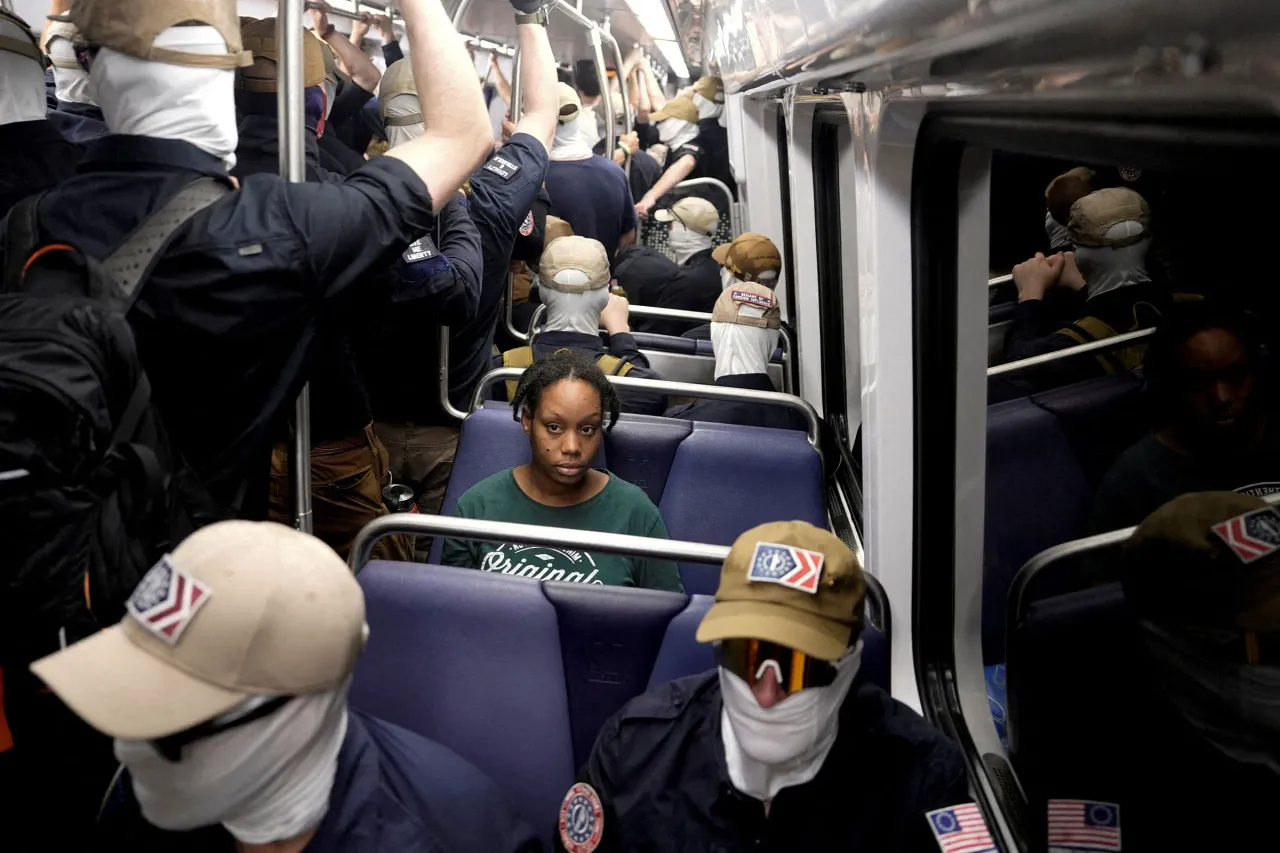
At first, there is very little to see. A Washington Metro carriage. Blue seats beneath fluorescent lights. Passengers travelling across the city on America's 250th Independence Day.
Nothing appears to demand our attention until we notice the faces. Almost every face is hidden.
Masks repeat across the carriage, flattening individuality into a pattern. Only one face remains uncovered. A Black woman sits quietly among the anonymous figures surrounding her. The photograph does not tell us whether anyone spoke, whether anyone exchanged a glance, or what the journey meant to any of them.
It records only that, for a fraction of a second, these people occupied the same space. Yet photographs have a peculiar way of acquiring lives of their own.
Cheney Orr's image travelled quickly after it was published. Newspapers reproduced it. Television discussed it. Social media turned it into a shorthand for arguments about race, democracy and America's unfinished history.
The camera had recorded a fraction of a second. The meanings attached to that fraction accumulated almost immediately. As the photograph travelled, its history began to grow.
The image became evidence of a divided nation. It became a meditation on citizenship and belonging. Critics discussed its composition. Commentators explained what it revealed about America. Historians may eventually place it within the visual record of the United States in 2026.
With every interpretation, the photograph acquired another layer of significance.But the person within it had a history too.
Only afterwards did we learn her name: Bernita Bowlding. Her family did not need the photograph to discover who she was. They already knew her as a person with relationships, responsibilities, memories and an everyday life that existed long before the camera arrived.
That distinction is easy to lose once a photograph becomes public.
Millions of people can recognise Bowlding's face without knowing much about the person attached to it. Her face becomes familiar through circulation while her life remains largely outside the frame. The photograph gives the public access to her appearance. It does not necessarily give them access to her experience.
This is one of photography's strange contradictions. It can preserve the appearance of someone with extraordinary precision while preserving very little of the life that appearance belonged to.
The photograph itself is remarkably honest about its limitations. It records where people stood, how they were dressed and how light fell across the carriage. It cannot tell us what anyone was thinking. It cannot tell us what happened before the train arrived, what was said afterwards or what became of those passengers when the doors opened.
The photograph gives us evidence, but not an entire history. Interpretation begins where the image falls silent. That silence is usually filled quickly. Critics interpret photographs. Newspapers contextualise them. Museums historicise them. Audiences attach their own experiences and arguments to them.
What we ask less often is what the photograph might be taking away from the person we are looking at.
The masks in Orr's photograph make this particularly visible. Almost everyone else in the carriage can disappear into anonymity. Their faces are concealed, so their participation in the photograph's afterlife is limited. Bowlding's uncovered face does the opposite. It makes her identifiable and therefore available to public interpretation.
The photograph gives her visibility while withholding almost everything that would allow us to know her.
There is no contradiction in saying that the photograph matters and that it does not tell us enough. The image may become an important document of a particular political moment. Orr's authorship and photographic choices deserve consideration. The photograph may acquire a significant place in the visual history of its time.
But none of that makes the photograph's history the same thing as Bowlding's history.
This matters because photographs are often treated as though the people within them become part of the image's story simply by appearing in it. They do not. A person can become central to a photograph's meaning while remaining absent from its history.
The family album understands this differently. A photograph of a grandmother may be visually unremarkable to everyone outside the family and indispensable to everyone inside it. The image does not need to become famous because the person already has a history that gives the photograph its meaning.
Public recognition and personal recognition are not the same thing.
Perhaps that is photography's quieter ethical problem. We often speak about photographs as preserving memory, but what they preserve most reliably is appearance.
Memory requires relationships, stories, names, context and people willing to carry those things forward. When a photograph becomes iconic, its history is almost guaranteed. The history of the person within it is not.
That is why looking beyond the photograph matters. Not because the image is useless, and not because interpretation is wrong, but because the photograph's growing importance can create the illusion that we have come to know the person inside it. We have not. We have encountered an image of a life.
The life itself continues elsewhere, carrying a history the photograph can neither contain nor tell us.
Foundation
This essay is part of theBLKGZE's Foundation series, which explores the ideas that shape photography, visual culture and the Black gaze.


