What Zun Lee saw
Beyond the stereotype
Zun Lee's Father Figure is often discussed as a corrective to stereotypes of Black fatherhood. The project emerged from Lee's own experience of fatherlessness and from his desire to photograph forms of Black masculinity that rarely appear in mainstream media. Across the series, fathers are shown caring, nurturing, teaching, supporting and loving their children. The work challenges a visual culture that has too often defined Black fatherhood through absence.
Yet the photographs themselves ask us to do something more than correct a misconception.
Listening for presence
Tina M. Campt encourages us to listen to images, to attend to the quieter frequencies that photographs carry. When we approach Lee's work in this way, the question shifts. Rather than asking whether Black fathers are present, we begin to ask what presence feels like.
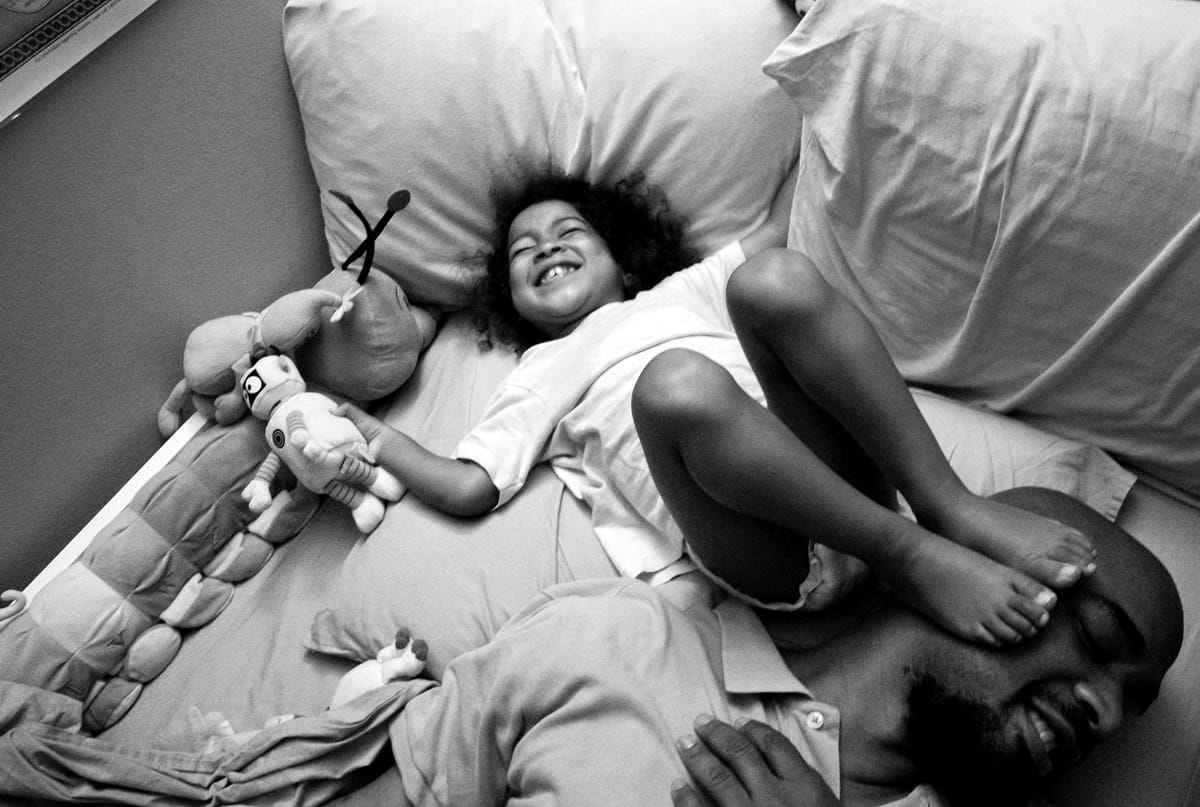
In this photograph, presence takes the form of ease.
The frequency of trust
A young child lies across a bed, laughing. Her legs stretch across the body of an adult man whose face is partially obscured beneath her feet. He smiles. Around them, pillows and toys fill the frame. The photograph offers no clear hierarchy between parent and child. Instead, their bodies appear intertwined within the playful disorder of a shared space.
The image hums with trust.
The unmade bed, the stuffed toys and the tangle of limbs all contribute to that frequency. None of these details are extraordinary. They belong to the texture of everyday family life. Yet together they reveal something profound: a relationship built through countless ordinary moments of care.
The everyday work of love
This is where Lee's photographs become most powerful. They are not simply arguments against stereotypes. They are records of intimacy. They invite us to recognise forms of Black life that have always existed but have too often gone unseen. The fathers in Father Figure are not exceptional. Their love is not remarkable because it exists. It is remarkable because Lee allows us to witness it without turning it into spectacle.
The longer we spend with the image, the quieter it becomes. The stereotype that initially frames the project begins to recede, leaving behind something more enduring. We are no longer looking at a photograph about Black fatherhood. We are listening to a photograph about trust, belonging and the everyday work of love.