The photograph and the question of authority
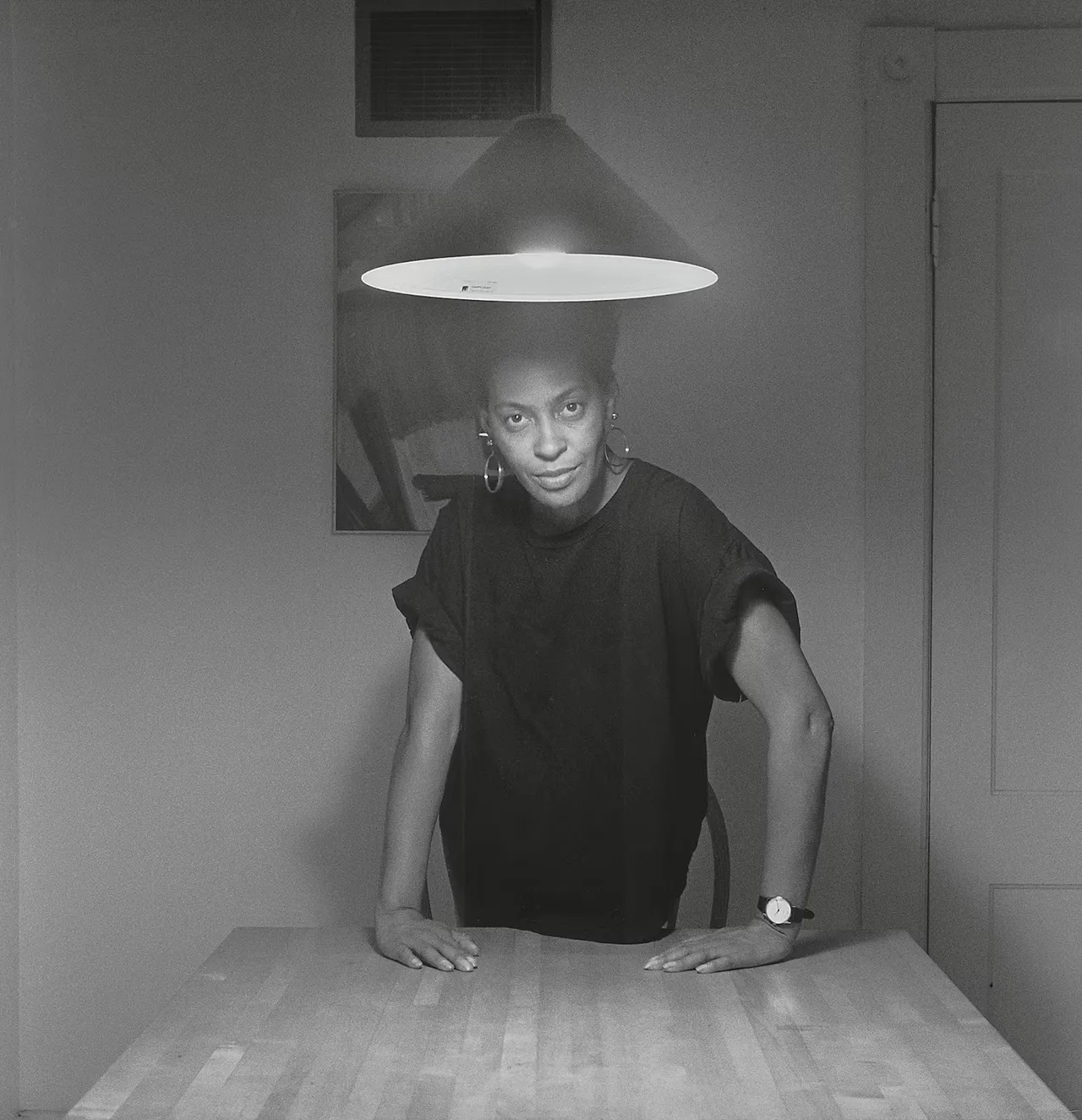
Carrie Mae Weems stands behind a wooden table, both hands resting firmly on its surface. A hanging lamp casts a circle of light around her face while the rest of the room recedes into shadow. Behind her hangs a framed picture. To one side is a door. Nothing in the photograph appears grand or theatrical. It is an ordinary interior, the kind of space that rarely attracts attention. Yet the image carries a remarkable sense of authority.
Part of that authority comes from the way Weems occupies the frame. She is neither performing for the camera nor submitting to its gaze. She looks directly towards the viewer with a composure that feels earned rather than assumed. The photograph gives the impression that she is entirely comfortable within the space she inhabits. Whatever conversation is about to take place, she appears to have already established its terms.
Beyond a seat at the table
The image prompts an interesting question about a phrase that has become almost unavoidable in discussions about representation. We are often told that success means securing a seat at the table. The metaphor appears whenever conversations turn to access, inclusion, or opportunity. Progress is measured by who has been invited into rooms that were once closed to them. The assumption underlying the phrase is that power exists elsewhere, and that the goal is to gain entry.
Weems' photograph suggests something different.
She is not seated at the table. More importantly, she does not appear concerned with whether she has been invited to it. The image shifts the conversation away from access and towards authorship. Rather than asking who is allowed into the room, it asks who defines what happens there. That distinction may seem subtle, but it reveals a fundamentally different understanding of power.
Who gets to define the terms?
Photography has long been shaped by questions of access. Who gets to make images, who gets to circulate them, and who gets to determine their meaning are questions that sit at the heart of the medium's history. For Black photographers, those questions have often been accompanied by another. Is recognition enough?
The history of photography offers countless examples of Black artists whose work has been celebrated while the structures surrounding it remained unchanged. Institutions have frequently welcomed the cultural value of Black creativity without surrendering much authority over how that creativity is exhibited, funded, collected, or understood. Recognition becomes a substitute for transformation. Visibility becomes confused with value.
Weems has spent much of her career examining precisely these tensions. Her photographs repeatedly explore how identity is shaped within spaces that appear ordinary but are deeply political. Kitchens, living rooms, dining tables, and domestic interiors become sites where larger questions about race, gender, power, intimacy, and belonging are negotiated. Her work reminds us that power does not only reside in boardrooms, galleries, or government buildings. It also exists in the places where people define themselves and one another.
The table occupies a particularly important place within this visual language. Across The Kitchen Table Series, it becomes a stage upon which relationships unfold and identities are tested. Friends gather. Lovers arrive and depart. Children appear. Moments of joy, loneliness, reflection, and uncertainty pass across its surface. The table is not simply furniture. It becomes a place where meaning is made.
Seen in this context, the photograph accompanying this essay takes on a deeper significance. The table is not a symbol of admission into someone else's world. It is a symbol of self determination. Weems stands behind it as both participant and author. She is not asking to be included within an existing narrative. She is creating one.
This perspective feels particularly relevant in a cultural landscape that often rewards visibility above all else. Social media metrics, awards, features, exhibitions, and institutional endorsements are frequently treated as evidence of success. While these forms of recognition can be valuable, they are not the same as ownership. They do not necessarily provide control over one's work, nor do they guarantee the ability to sustain a creative practice over time.
Weems has spoken candidly about this distinction. Reflecting on her career, she has noted that acknowledgement and awards are meaningful, but they do not always translate into the kind of serious valuation that artists need in order to thrive. Her observation highlights a tension that many photographers recognise. Being celebrated and being supported are not always the same thing.
Refusal as a creative practice
Scholar Tina Campt's writing on refusal offers a useful way of understanding what follows from this realisation. In Listening to Images, Campt describes refusal not as withdrawal but as a practice of reorientation. Refusal involves redirecting energy away from systems that demand compromise and towards forms of self definition. It is less concerned with rejection than with creation. The question is not what one is walking away from. The question is what one is building instead.
Viewed through Campt's lens, Weems' photograph becomes a study in refusal. The image does not depict resistance in any dramatic sense. There are no raised voices or visible confrontations. Instead, it presents a quieter form of authority. The refusal lies in the certainty with which the subject occupies the space. Nothing in the photograph suggests a desire for permission or approval. The image is grounded in the assumption that legitimacy does not need to be granted by an external authority.
Legacy on one's own terms
That idea has important implications for how we think about legacy. Legacy is often imagined as something bestowed by institutions after the fact. Museums acquire work. Awards are handed out. Histories are written. Yet the photographers who reshape the medium rarely begin by seeking legacy. They begin by establishing their own terms of engagement with the world. Legacy emerges from that process rather than the other way around.
Returning to Weems' photograph, what remains striking is its sense of clarity. The image does not present power as something distant or inaccessible. Nor does it frame success as a matter of gaining entry into spaces controlled by others. Instead, it offers a vision of authorship grounded in self possession, conviction, and imagination.
The photograph ultimately asks a question that extends far beyond photography. What becomes possible when the goal is no longer to secure a place at someone else's table, but to create spaces in which entirely different conversations can take place? Weems does not provide a direct answer. She does something more interesting. She shows us what that possibility looks like, then leaves us to consider how we might recognise it in our own lives and work.


