"Wi likkle but wi tallawah" is one of Jamaica's most enduring declarations of self understanding. The phrase acknowledges the island's small size while rejecting the assumption that size determines significance. It is an answer to anyone who mistakes geography for influence, population for power, or visibility for impact.
Few countries have shaped the modern world as profoundly as Jamaica. Its music, language, fashion, politics, spirituality, and cultural imagination have travelled far beyond its shores. Jamaica's influence can be heard in London, New York, Toronto, Lagos, Tokyo, and Johannesburg. It lives in sound systems and churches, in poetry and protest movements, in hairstyles, slang, and political thought.
Yet photography has often struggled to grasp this scale.
Again and again, Jamaica appears in photographs as a place of violence, poverty, danger, or exotic spectacle. These realities exist, but they do not explain Jamaica. They do not account for the cultural worlds that have emerged from the island, nor do they reveal the histories, relationships, and forms of knowledge that continue to shape Jamaican life.
The challenge of photographing Jamaica is not simply one of representation. It is one of scale. How does a photograph account for a place whose cultural influence has travelled so much further than its geography?
Three recent photobooks reveal how different photographic approaches either reinforce that reduction or challenge it. Boogie's A Wah Do Dem, Lúa Ribeira's Noises in the Blood, and Andrew Jackson's From a Small Island each attempt to engage with Jamaica and Jamaican identity. Together, they raise an important question: what does it mean to photograph a place whose significance exceeds the limits of the frame?
Seeing only the wound
One photograph from A Wah Do Dem captures many of the tensions that run throughout Boogie's book. A man lifts his shirt to reveal a handgun tucked into his waistband. The frame excludes his face. We see his hands, his clothing, his belt, and the weapon itself. Almost everything else has been cropped away.
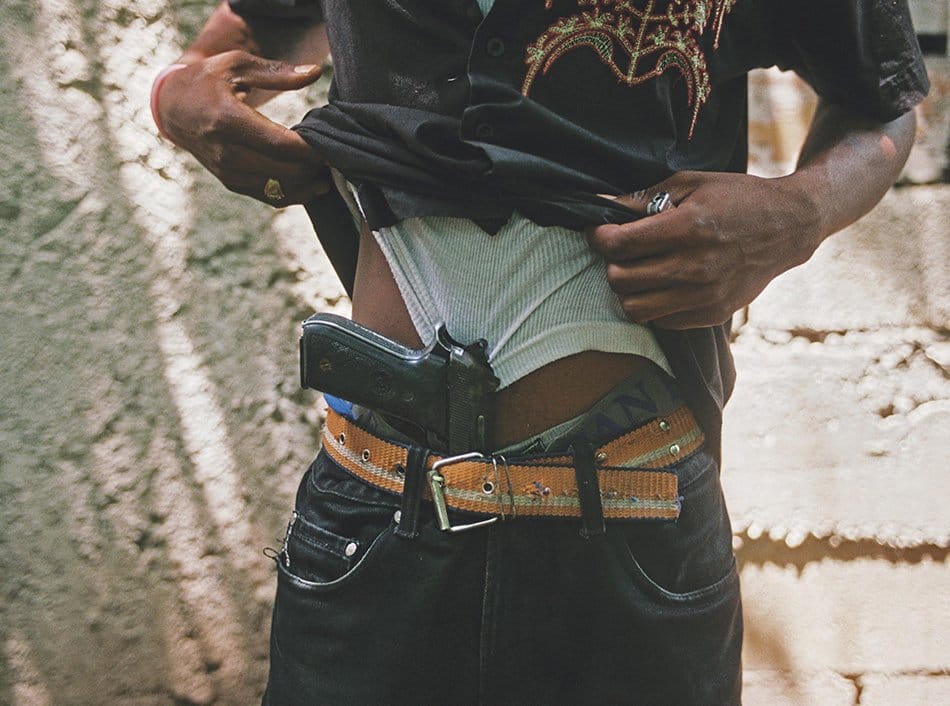
The photograph is organised around a single act of revelation. Our attention is directed immediately towards the gun because the composition gives us nowhere else to look. The image offers remarkably little information about the person standing before us. We do not know his name, his age, his occupation, or the circumstances that brought him into the frame. We are asked to encounter the weapon before we encounter the man.
This is what makes the photograph more complicated than a simple document of violence. The issue is not whether the gun is real. It clearly is. Nor is the issue that Jamaica contains violence. Every society does. The question is what happens when violence becomes the organising principle of an image.
Photographs are never neutral records. They establish relationships between subjects and viewers. They teach us where to look, what to notice, and what to remember. In this image, identity is displaced by symbolism. The individual becomes secondary to what the weapon signifies. A person becomes a sign through which danger is communicated.
Looking across A Wah Do Dem, similar patterns emerge. Boogie's camera is often physically close to its subjects, yet emotionally and culturally distant from the worlds they inhabit. Faces disappear into shadow. Interiors become stages for tension. Moments of confrontation accumulate. Again and again, the viewer is directed towards the extraordinary rather than the everyday.
The result is a Jamaica shaped largely through crisis. What disappears are the social and cultural forces that make Jamaican life intelligible beyond violence itself. The music, humour, spirituality, language, creativity, and forms of community that have allowed Jamaican people not merely to survive, but to influence the world far beyond the island's shores, remain largely outside the frame.
This matters because "Wi Likkle But Wi Tallawah" is ultimately a statement about scale. It reminds us that Jamaica's significance cannot be measured by its size. Yet photographs such as this risk shrinking the island to a single story. A viewer unfamiliar with Jamaica could leave the book believing they have seen something important, and they would be right. What they would not have seen is the scale of the culture itself.
The photograph shows a wound. What it struggles to show is the body that carries it.
When culture becomes performance
Lúa Ribeira's Noises in the Blood approaches Jamaica through a very different visual language. Where Boogie's photographs are organised around confrontation, Ribeira's images are shaped by performance. The photographs are carefully composed, highly stylised, and often visually arresting.
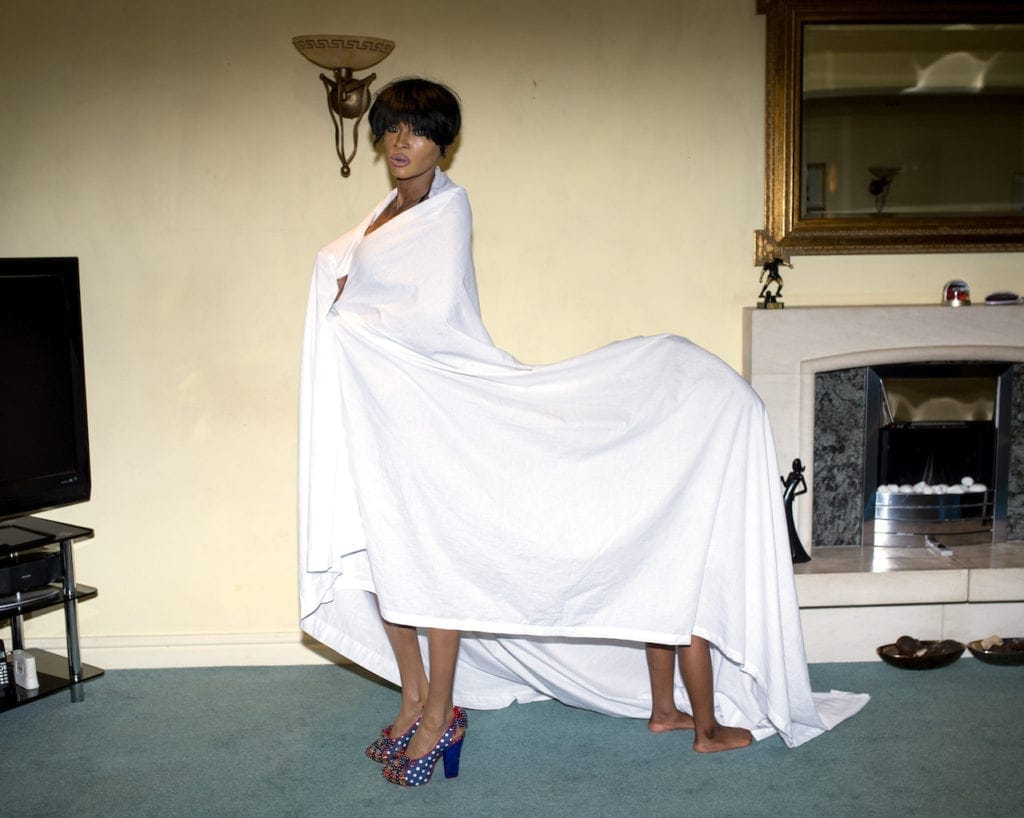
One image in particular captures both the strengths and limitations of the project.
A woman stands in a domestic interior draped in a large white sheet that stretches across the room. Beneath the fabric, a second figure is partially concealed. We see bare legs emerging from underneath the cloth, transforming two bodies into a single sculptural form. The scene unfolds in an ordinary living room. A television sits to one side. A fireplace occupies the background. The flash creates a heightened sense of theatricality, turning a familiar domestic space into a stage.
The photograph immediately attracts attention because it resists easy interpretation. The sheet functions as costume, prop, and disguise simultaneously. The image feels playful, strange, and carefully choreographed. Rather than documenting an event, Ribeira appears to be constructing one.
The photograph is not attempting to show Jamaica directly. It is attempting to translate aspects of Jamaican culture into a visual language built around gesture, performance, and transformation.
Yet the image also raises an important question. What happens when culture is encountered primarily through performance?
Looking at the photograph, one is struck by how much remains outside the frame. We do not know who these individuals are. We learn little about the social world they inhabit. Their relationship to one another remains unclear. The photograph encourages us to admire its visual inventiveness, but it offers fewer points of entry into the lives of the people before the camera.
The image understands that performance is central to how identity is negotiated and expressed. What it struggles to convey is the wider cultural world from which that performance emerges.
This does not diminish the photograph's achievements. The image is thoughtful, imaginative, and visually sophisticated. The challenge facing photographs of Jamaica is not simply how to represent what is visible. It is how to convey the scale of the worlds that exist behind what is visible.
In Noises in the Blood, Jamaica often appears as a source of visual inspiration. What remains harder to grasp is the full cultural force that makes that inspiration possible. The result is a body of work that moves beyond crisis but does not entirely escape reduction. Jamaica appears larger than it does in Boogie's photographs, yet it still feels smaller than the culture that produced it.
Photographing beyond the frame
Andrew Jackson's From a Small Island approaches Jamaica from a fundamentally different position. Rather than searching for crisis or spectacle, Jackson appears interested in relationship. His photographs move patiently through questions of memory, migration, belonging, and inheritance. The images do not ask what Jamaica looks like. They ask how Jamaican lives are carried across time and place.
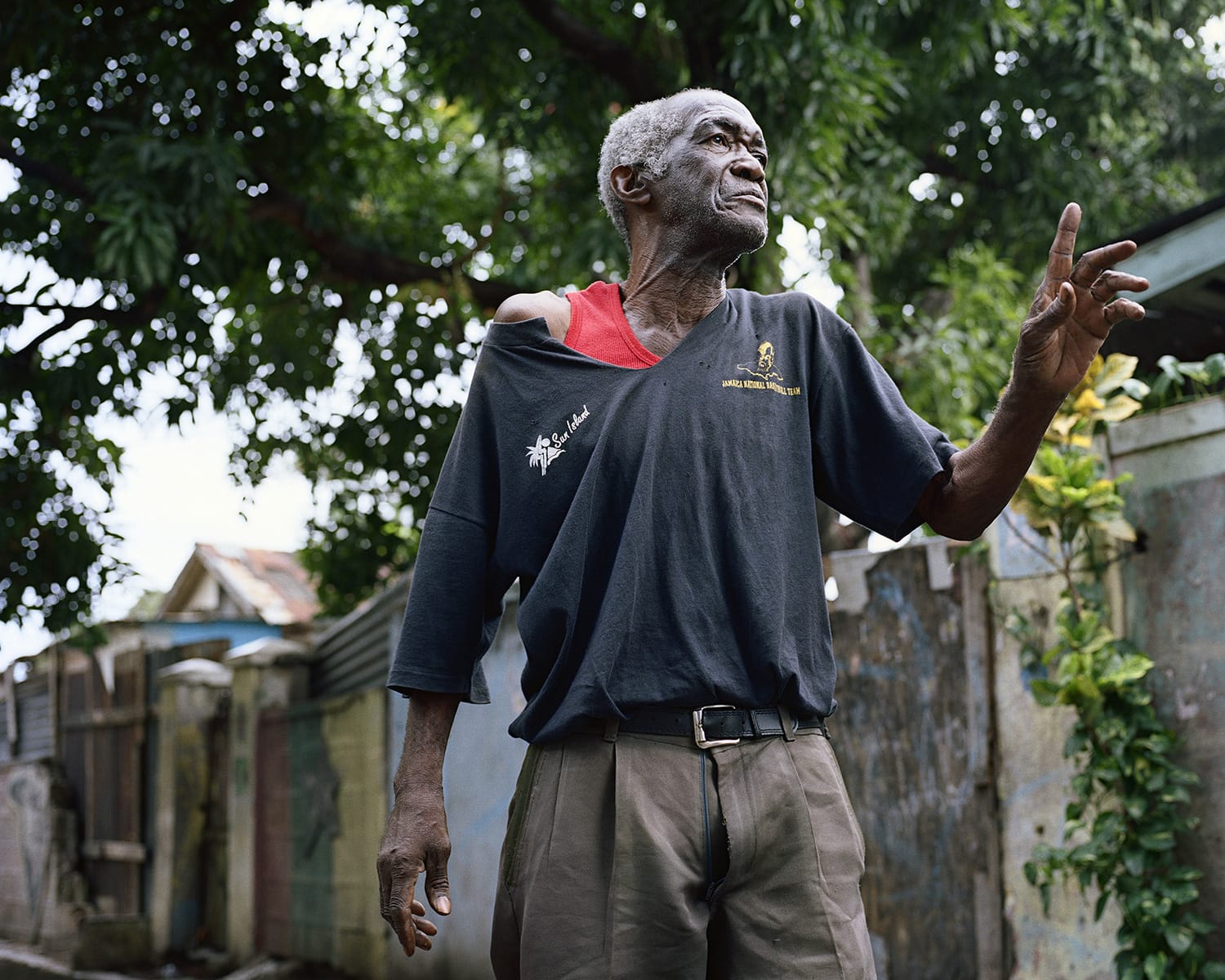
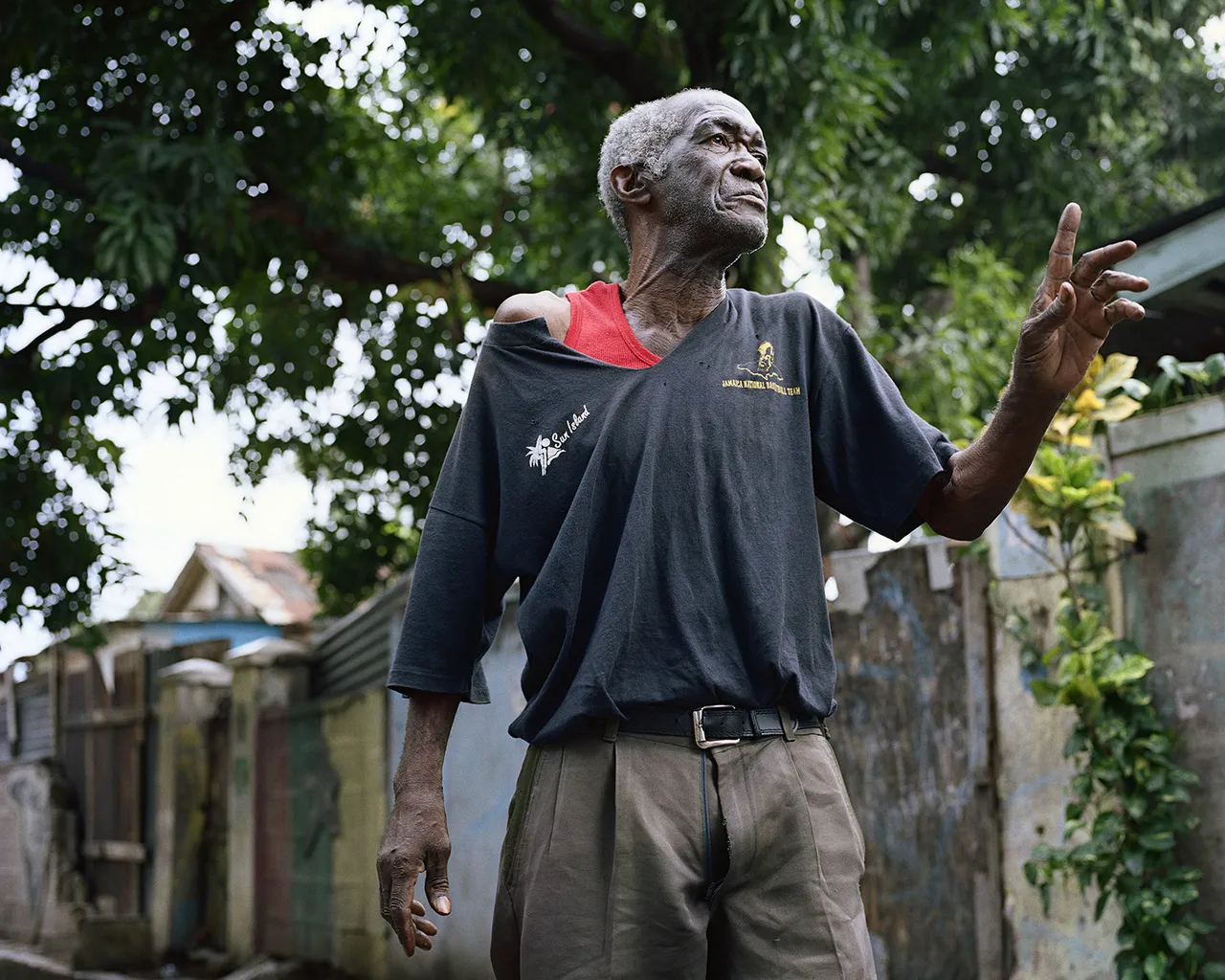
One photograph in particular captures this approach. An older Jamaican man stands within a modest urban landscape. His head tilts upward. One hand is raised slightly. His mouth is partially open, as though he has paused in the middle of a thought, a conversation, or a memory. Behind him are weathered fences, plants, and the accumulated textures of everyday life.
Unlike the photograph in A Wah Do Dem, Jackson does not organise the frame around a single symbol. Unlike the photographs in Noises in the Blood, he does not rely on performance to hold our attention. Instead, the image derives its power from presence. The man is allowed to exist as a person rather than an example. He is not reduced to a social problem, a cultural signifier, or a visual spectacle.
The raised hand feels unfinished. It points beyond the photograph itself, suggesting a conversation that began before the shutter was released and will continue after the image ends. Rather than closing meaning down, the photograph opens it up. Viewers are invited to imagine a life rather than consume an image.
The image understands something that many photographs of Jamaica struggle to grasp. Jamaica is not simply a place. It is a network of relationships extending far beyond the island itself. Jamaican identity has been shaped through movement, exchange, adaptation, and survival. Its influence travels through people as much as through geography.
The title From a Small Island is therefore particularly resonant. Jackson's photographs recognise that the significance of Jamaica cannot be measured by physical scale alone. The island may be geographically small, but the histories, communities, and cultural worlds connected to it are immense.
The phrase "Wi Likkle But Wi Tallawah" captures precisely this idea. Jackson's photographs do not attempt to explain Jamaica through a single story. Instead, they create space for complexity, contradiction, memory, and relation. Looking at them, one becomes aware not only of what is visible within the frame, but also of everything that extends beyond it.
That is what makes From a Small Island such an effective response to the challenge posed by the title of this essay. The photographs understand that Jamaica's greatest stories have never been about size. They have always been about reach.
Wi Likkle But Wi Tallawah
In Boogie's photograph, a gun becomes the story. In Ribeira's photograph, a performance becomes the story. In Jackson's photograph, a man remains larger than the story that could be told about him.
That difference reveals something important about photography. The question is not whether a photograph is accurate. The question is whether it leaves room for the fullness of a life, a culture, or a history to remain visible.
"Wi Likkle But Wi Tallawah" is ultimately a reminder that significance cannot always be measured by what appears immediately before us. The same is true of photographs. Their deepest meanings are often found not in what they contain, but in whether they allow us to sense everything that extends beyond the frame.
The island may be small.
The world it contains is not.


