What Khadija Farah saw
Four women beneath an open sky
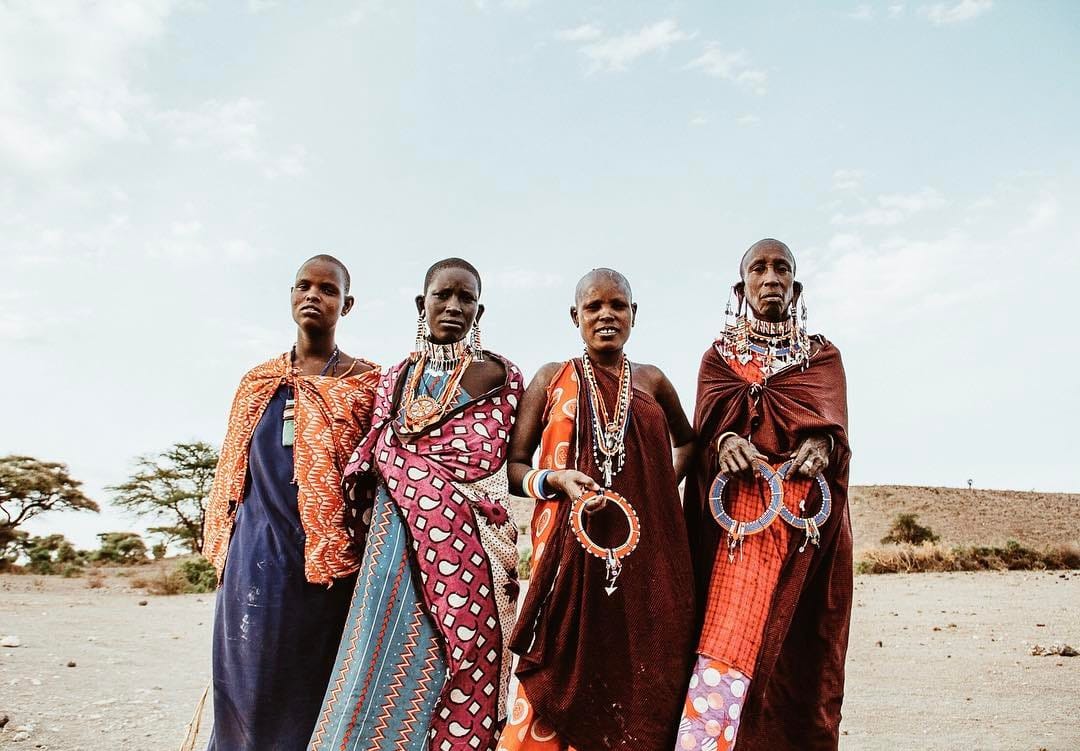
Four women stand beneath an open sky, their figures framed against the vastness of the Kenyan landscape. They hold necklaces, bracelets and beaded ornaments in their hands. There is no dramatic action to explain the scene. The women are not making jewellery, selling it or demonstrating a tradition for the camera. Instead, they stand together in a moment of stillness that feels both ordinary and deliberate.
At first glance, the photograph appears straightforward. The bright colours of the women's clothing immediately draw the eye, as does the intricate beadwork they carry. Yet the longer we spend with the image, the more it resists a simple reading. Although the women belong to a shared cultural tradition, they do not present themselves as a single collective identity. One tilts her head slightly. Another meets the camera's gaze directly. A third carries the hint of a smile. Their clothing connects them, but their expressions remind us that each person occupies the photograph on her own terms.
Listening Beyond What We See
Tina M. Campt argues that some photographs invite us not only to look, but to listen. Rather than asking what an image shows, she encourages us to consider what it asks of us and what becomes audible when we spend time with it. Some photographs announce themselves loudly through spectacle or drama. Others operate at a quieter frequency. Their meaning emerges gradually through attention.
Khadija Farah's photograph belongs to the latter tradition. Nothing in the image competes for our attention through movement or performance. The women stand together beneath an immense sky, neither explaining themselves nor offering themselves up for easy interpretation. The photograph slows us down. It encourages us to remain with the women rather than rushing towards conclusions about them.
Seeing people before symbols
This matters because photography has often struggled to represent African communities without reducing individuals to symbols. Viewers are encouraged to see culture before they see people. Clothing, jewellery and customs become visual shorthand, flattening complex lives into familiar narratives. Farah takes a different approach. While the beadwork remains important, it never overwhelms the women who carry it. The photograph continually redirects our attention back to their presence.
The jewellery tells stories of craftsmanship, memory and belonging, but those stories remain inseparable from the people holding them. Farah does not isolate cultural objects from lived experience. Instead, she photographs culture as something embodied and carried. The necklaces and bracelets matter because they exist within relationships, histories and communities rather than apart from them.
As we spend more time with the image, another quality begins to emerge. The stillness of the photograph feels less like passivity and more like confidence. The women do not need to perform authenticity for the viewer. They do not need to explain the significance of what they wear. Their presence alone is enough. The photograph honours that certainty by refusing to turn them into spectacles.
What Khadija Farah saw
What Khadija Farah gives us, then, is not simply a portrait of Maasai culture. She gives us a photograph that asks us to pay attention to how culture is lived through people. The image invites us to recognise both community and individuality, both tradition and personal presence. It reminds us that culture does not exist independently of those who carry it forward.
The longer we look, the less the photograph becomes about the objects in the women's hands and the more it becomes about the women themselves. Their lives extend beyond the frame, beyond the categories we might place upon them and beyond the stories we assume we already know. Farah's photograph does not attempt to tell us everything. Instead, it asks us to listen carefully enough to recognise that there is always more to hear.