What deserves our attention?
Look closely at this photograph.
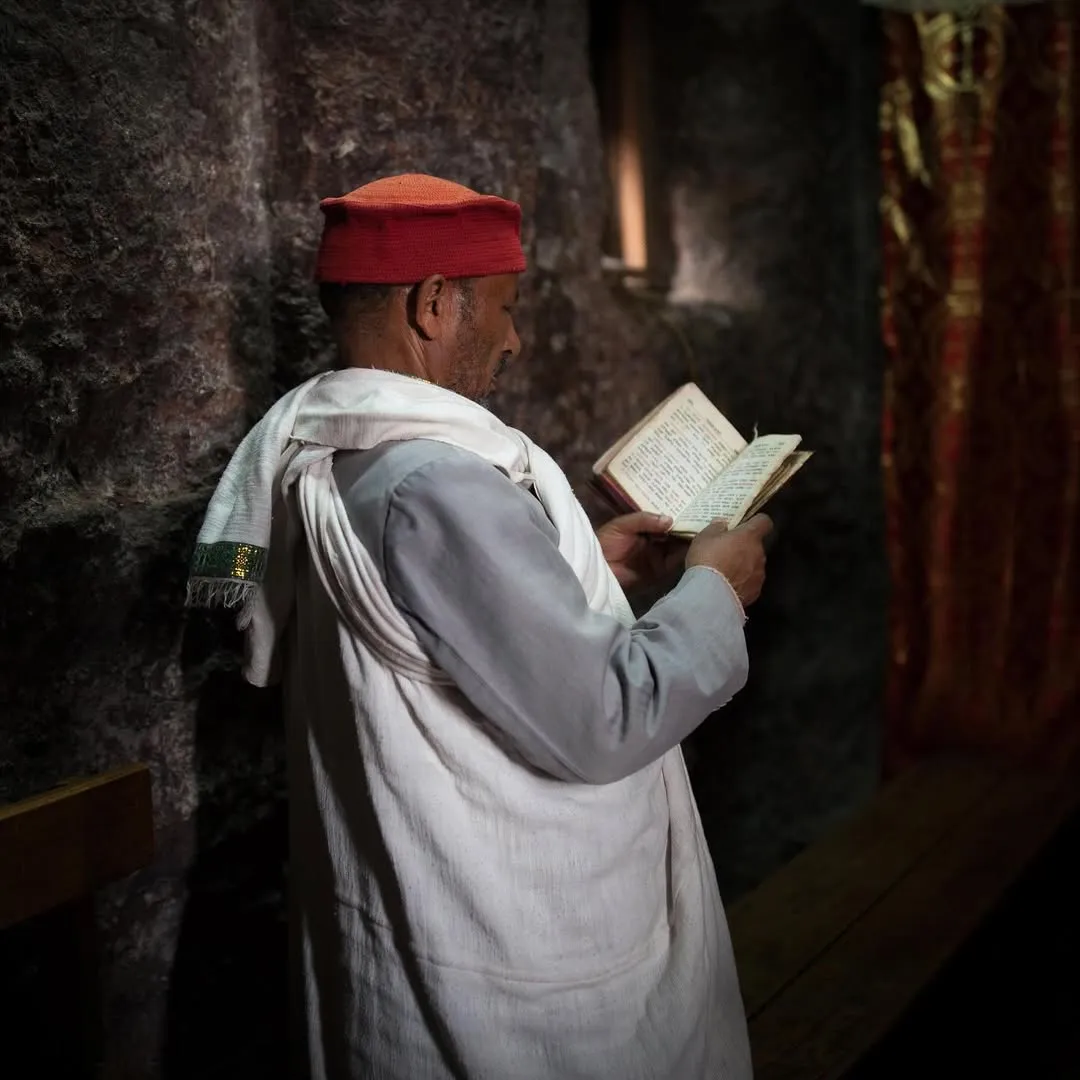
A priest stands against a stone wall, his attention fixed on a prayer book held gently in his hands. Light enters from the side of the frame, illuminating the pages and catching the folds of the white garment draped across his shoulders. Everything else recedes into shadow. There is no dramatic gesture, no spectacle, no attempt to command our attention. Instead, the photograph asks us to slow down.
A man and a prayer book
The image was made inside Bete Medhanialem, one of the rock hewn churches of Lalibela in northern Ethiopia. Yet Hilina Abe does not photograph the church in the way many visitors do. We are not presented with a sweeping view of the architecture or a monument framed for admiration. Instead, she directs our attention towards a priest reading.
This choice matters because photography is never neutral. Every photograph reflects a decision about what deserves attention. Standing inside one of Africa's most celebrated religious sites, Abe could have focused on the scale of the church, the craftsmanship of its construction, or the crowds that pass through it each year. Instead, she chooses a man, a book, and a moment of concentration.
That decision fundamentally changes the story being told. The significance of Lalibela is not located solely in stone walls carved centuries ago. It is found in the people who continue to inhabit these spaces through prayer, study, ritual, and devotion. The church matters because it remains alive.
Lalibela teaches you stillness
When sharing the photograph, Abe wrote that "Lalibela teaches you stillness". The image helps us understand what she means.
Stillness here is not inactivity. The priest is reading. His eyes move across the page. His hands hold the book open. Yet the photograph feels calm because everything within it is ordered towards a single purpose. Nothing competes for attention. Nothing distracts from the act itself.
Tina M. Campt argues that some photographs reveal themselves through their quieter frequencies. Rather than demanding attention through drama or spectacle, they ask us to listen. Not for sound, but for forms of life that are often overlooked. Abe's photograph operates in this register. Its significance emerges slowly through concentration, repetition, and practice.
The longer we spend with the image, the more we begin to understand that stillness is not the absence of meaning. It is a way of encountering it.
Memory in practice
The most important object in the photograph may not be the church but the book itself.
Its pages appear worn through use. This is not a ceremonial object displayed for visitors. It is a working object, handled repeatedly over time. The book reminds us that memory does not survive on its own. It survives because people carry it forward.
Photography often encourages us to think of memory as something stored in archives, monuments, or historical sites. Abe's image suggests something different. Memory is also preserved through practice. Through reading. Through prayer. Through acts repeated so often they become part of everyday life.
The photograph transforms our understanding of Lalibela. Rather than presenting it as a relic of the past, Abe shows it as a place where history remains active in the present. The church is not simply remembered. It is lived.
Seeing culture differently
For generations, photography has shaped how audiences understand Africa. Many of its most widely circulated images have focused on crisis, conflict, poverty, or spectacle. Even positive images have often framed African cultures as attractions to be observed rather than worlds to be understood.
Abe offers another possibility.
She does not ask us to marvel at Lalibela. She asks us to pay attention to it. The priest is not presented as an exotic figure or a symbol of a distant past. He appears as a reader, a learner, and a participant in a living tradition. The photograph invites us to understand culture not as performance, but as practice.
This is one of the ways Black photographers expand photography itself. They do more than document communities or preserve histories. They challenge assumptions about what deserves attention. They reveal forms of knowledge that dominant photographic traditions have often overlooked. They teach us new ways of seeing.
Perhaps this is what Hilina Abe saw in Lalibela. Not simply a famous church or a remarkable example of architecture, but a community sustained through faith, memory, and repetition. A place where culture is carried forward through ordinary acts that rarely make headlines and seldom become iconic photographs.
The image leaves us with a larger question. What if photography spent less time searching for spectacle and more time attending to the practices that sustain people's lives? What histories, memories, and ways of knowing might become visible then?
Abe's photograph suggests that some of photography's most important lessons are found not in extraordinary events, but in the quiet moments we are most likely to overlook.


