The gaze comes first
The first thing you notice is not the hoodie. It is the gaze.
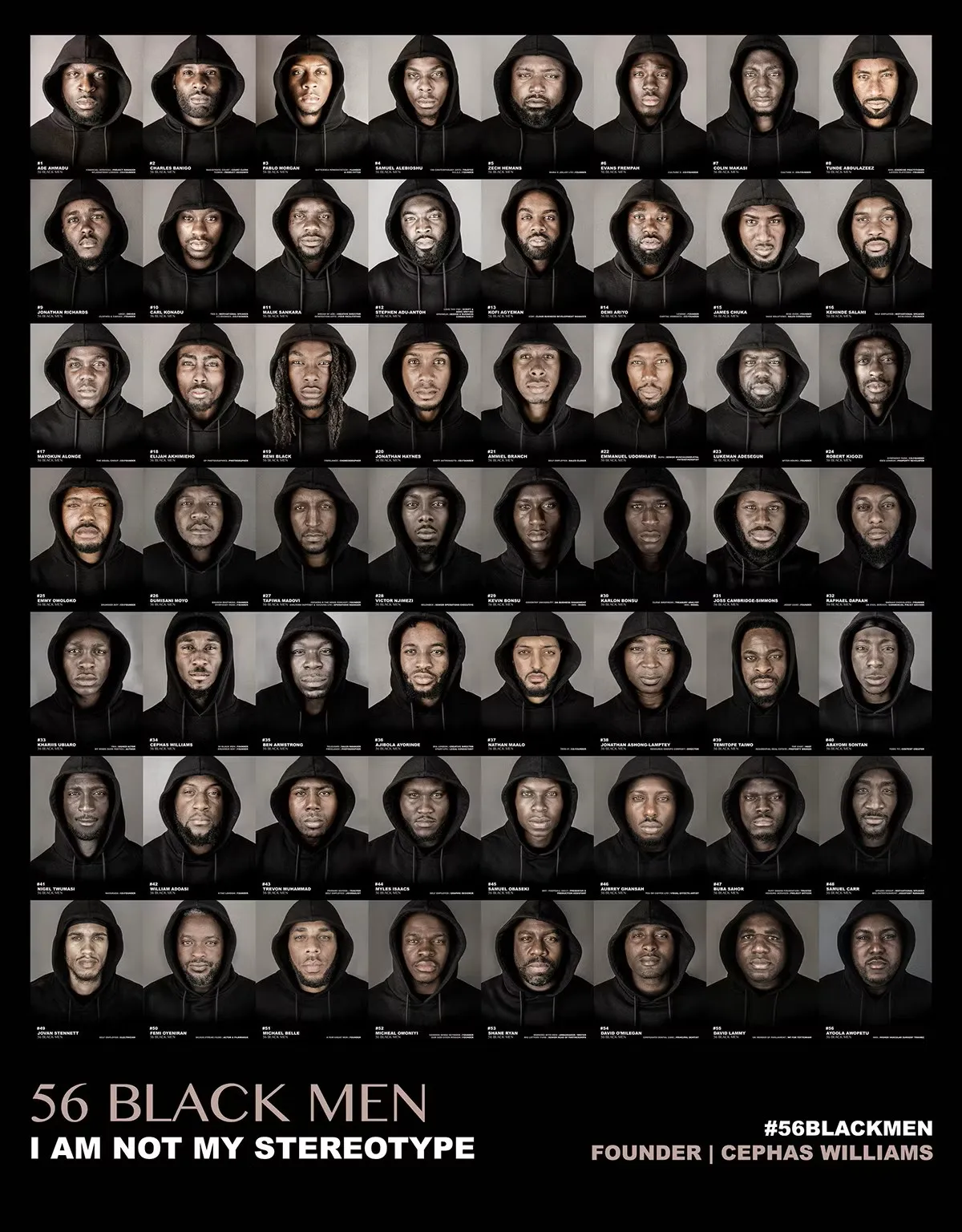
One after another, the men in Cephas Williams' 56 Black Men look directly into the camera. There is no performance of toughness. No attempt to entertain. No effort to soften themselves for the comfort of the viewer. They simply meet the lens with the quiet confidence of people accustomed to being looked at, but less accustomed to being seen.
That distinction lies at the heart of the project.
When 56 Black Men launched in 2019, it arrived in response to a familiar pattern. Black men in Britain often appeared in public imagery through a narrow set of narratives. They were discussed in relation to crime statistics, gang violence, social problems, or sporting achievement. Even when the stories differed, the visual language often remained the same. Black men were represented as symbols long before they were recognised as individuals.
Williams' intervention was deceptively simple. He invited fifty six Black men from different professions, backgrounds, and walks of life to be photographed wearing hoodies. Teachers, entrepreneurs, politicians, creatives, community leaders, and business owners all appeared in the same garment that British culture has repeatedly transformed into a symbol of suspicion.
A hoodie is not the story
The photographs ask an uncomfortable question. If these men are respected professionals, mentors, fathers, and leaders while wearing a hoodie, what exactly was the problem with the hoodie in the first place?
The power of the project comes from the way it exposes the fragility of stereotypes. The hoodie has never carried meaning on its own. Its meaning has always depended upon who is wearing it and who is doing the looking.
The garment functions almost like a photographic experiment. By keeping one visual element constant across every portrait, Williams forces viewers to confront the assumptions they bring to the image. The stereotype begins to collapse under the weight of its own contradictions. The same item of clothing appears on a teacher, a politician, a filmmaker, a businessman, and a community leader. What changes is not the hoodie. What changes is our understanding of the person wearing it.
The photographs reveal that the problem was never the garment itself. The problem was the stories attached to it.
What portrait photography teaches us to see
Photography plays an important role in that process.
Photographs do not simply record identity. They help construct it. They shape how people are recognised, categorised, remembered, and understood. For generations, photography has participated in the production of racial stereotypes, often presenting Black men as threats, spectacles, or social problems. The camera has frequently been used to confirm assumptions rather than challenge them.
56 Black Men works because it reverses that relationship.
Looking through the portraits, one becomes aware of how little the images give the viewer to rely upon. The hoodie remains constant. The background is often simple. There are few visual cues directing us towards a predetermined conclusion. Instead, the viewer is left with a face, an expression, and a gaze.
Each portrait becomes an encounter rather than an explanation.
The photographs refuse the shortcuts through which people are often understood. There are no dramatic narratives embedded within the frame. There is no spectacle to distract us. What remains is the individual standing before the camera.
Beyond the stereotype
Some of the men appear thoughtful. Others appear confident. Some seem warm and approachable. Others seem reserved. Together, the photographs reveal something obvious yet frequently overlooked: Black men are not a category. They are individuals.
This may sound self evident, but it represents a significant shift in how photography has often approached Black identity. Too many images ask viewers to see Black men as representatives of a social issue. Williams' portraits ask viewers to recognise them as people whose lives exceed any single narrative.
What makes the project effective is that it does not attempt to replace one stereotype with another. The men are not presented as exceptional examples designed to reassure the viewer. Nor are they transformed into symbols of achievement. They are simply allowed to exist in their complexity.
That complexity matters because stereotypes depend upon simplification. They flatten people into easily recognisable types. The portraits in 56 Black Men resist that process by refusing to tell viewers exactly what to think. Instead, they create space for individuality.
From subject to participant
The project also reveals something important about self representation. These photographs are not attempting to explain Black men to a wider audience. They are not educational posters disguised as portraiture. Instead, they create space for Black men to occupy the frame without justification.
That is a subtle but meaningful difference.
Throughout the history of photography, Black people have often been photographed in ways that required them to perform a role for someone else's understanding. They were asked to illustrate poverty, resilience, danger, suffering, athleticism, or success. Their value frequently depended on what they could represent.
In 56 Black Men, the men are not illustrations for a broader argument. The photographs begin with the assumption that their presence is enough.
This is where the project connects most clearly to what many writers describe as the Black gaze. The Black gaze is not simply about photographing Black subjects. It is about shifting the terms of visibility itself. It asks what happens when Black people are no longer treated as objects of observation but as participants in the production of meaning.
Williams' portraits do not ask viewers to look at Black men. They ask viewers to recognise how they have been taught to look at Black men.
The refusal of reduction
That distinction remains as relevant today as it was when the project first launched.
The stereotypes challenged by 56 Black Men have not disappeared. The visual habits that shape public perception continue to influence media coverage, political discourse, and everyday encounters. The photographs remain powerful because the conditions that made them necessary have not entirely gone away.
Yet the lasting significance of the project extends beyond the correction of stereotypes.
At its best, photography does more than challenge misconceptions. It expands our capacity to see. Looking through 56 Black Men, one becomes aware that the real achievement of the project is not that it replaces a negative image with a positive one. It is that it refuses reduction altogether.
The men in these portraits are not presented as heroes, victims, role models, or cautionary tales. They are allowed something photography has too often denied Black subjects: complexity.
Meeting the gaze
The photographs do not ask us to admire the men they depict. Nor do they ask us to feel sympathy for them. They ask something more demanding.
They ask us to meet their gaze.
In doing so, the project shifts the burden of interpretation away from the subject and towards the viewer. The question is no longer who these men are. The question becomes why society has been so willing to see them through such narrow frames in the first place.
The lasting power of 56 Black Men lies in this reversal. The portraits remind us that photography is never simply about who appears in front of the camera. It is also about the assumptions carried by the people looking at the image.
By stripping away familiar narratives and visual clichés, Williams creates portraits that are remarkably direct. The men are not reduced to symbols, statistics, or headlines. They remain people, and that simple act of recognition feels quietly radical.
The photographs do not tell us who these men are.
They remind us that no photograph ever could.


