What happens when nothing happens?
Photography has learned to recognise the event. But most lives are made from repetition, routine and presence. What happens when we learn to see those things as significant too?
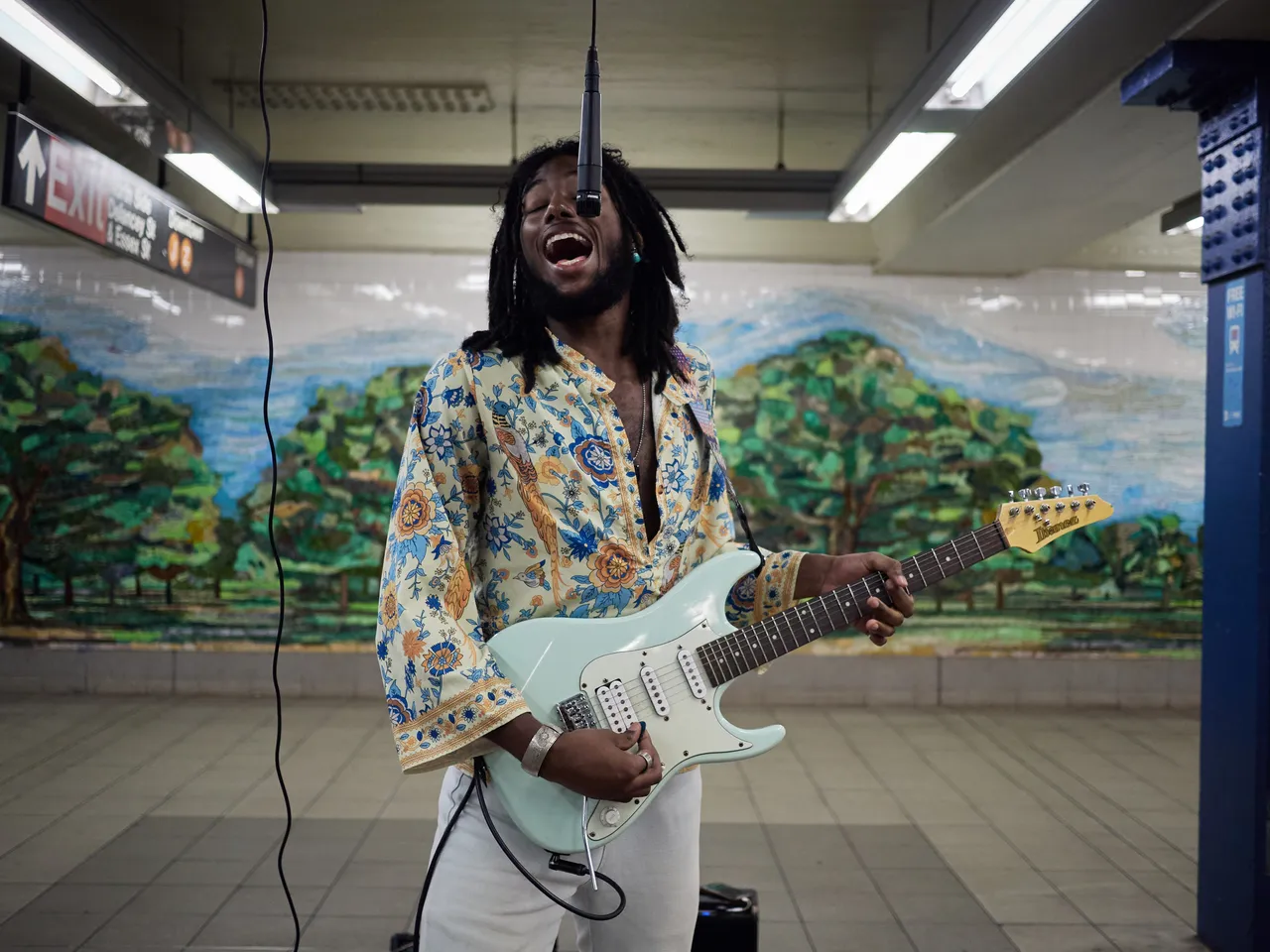
A man stands beneath fluorescent lights in a New York subway station. His eyes are closed. One hand grips an electric guitar. A microphone hangs in front of his face. Behind him, a tiled mural depicts trees and open sky, turning part of the station wall into an imagined landscape.
The photograph feels strangely calm.
Nothing dramatic appears to be happening. There is no obvious climax, no gesture that changes the scene, no event demanding our attention. The musician is singing, but the photograph does not feel as though it has captured the peak of a performance. Instead, the camera seems to have entered something already underway.
That is an unusual thing for photography to ask us to value.
We have inherited a particular idea of what makes a photograph significant. The decisive moment, the instant when action, timing and composition align, has become one of the medium's most enduring ways of understanding itself. It makes sense for photographs of war, protest, sport or disaster. Something happens, the camera catches it, and the image becomes a record of the event.
But most life does not happen like that.
Most of life is repetition. Going to work. Meeting friends. Attending church. Raising children. Making music. Sitting with family. Walking through the same streets. Returning to the same places. These things rarely announce themselves as history, yet they are where relationships are formed, cultures are sustained and memories accumulate.
Photography has often been better at recognising the event than the life surrounding it.
This is where Roy DeCarava becomes important. His photographs of Harlem repeatedly return to musicians, families, children, neighbours and ordinary encounters. People wait, walk, listen, sit and occupy their surroundings. The photographs can appear quiet, particularly when measured against photography's appetite for action.
But quiet does not mean empty.
DeCarava understood that a life could be photographically significant without first becoming an event. His photographs do not need their subjects to be performing history for the camera. They ask us to look at presence itself: the atmosphere of a place, the relationship between people, the particular quality of a gesture or the feeling of simply being there.
This is more than a choice of subject. It is a different idea of what photography is capable of knowing.
When photography concentrates too heavily on events, it risks making ordinary life appear like background. History happens somewhere else, we are encouraged to think, while people wait in between its important moments. But a community is not sustained by its exceptional moments. It is sustained by repetition, ritual, familiarity and care.
Black photographers have long made this visible.
Their photographs of neighbourhoods, family gatherings, churches, clubs, streets and social spaces do not simply provide a more positive representation of Black life. They challenge the assumption that Black life becomes photographically important when something dramatic happens to it.
That distinction matters. To say that photography should show more joy, beauty or ordinary life can easily become another demand for representation. Black people are then expected to appear resilient, celebratory or inspirational instead of suffering.
The deeper challenge is not to replace one approved image with another. It is to loosen the idea that Black life needs to perform significance at all.
The subway musician does not need to represent Black creativity. He does not need to symbolise community, resilience or urban culture. He is simply there, making music in a place built for people to pass through. The photograph's significance begins partly with the photographer deciding that this was worth stopping for.
That decision is never neutral.
Every photograph contains a judgement about attention. Something was noticed while other things were allowed to disappear. The camera does not merely record the world. It participates in deciding which parts of the world become visible enough to be remembered.
This is why documenting the ordinary matters. It is not because ordinary photographs are somehow morally superior to dramatic ones. Nor is it because every quiet moment contains a hidden masterpiece. It is because what we repeatedly photograph teaches us what we believe is worth looking at.
The family photograph understands this instinctively. A birthday, a graduation, a Sunday afternoon or a person sitting at the kitchen table can matter enormously without ever becoming historically significant. The photograph preserves something because someone decided that the life itself was worth remembering.
That is a different measure of significance.
Returning to the musician, the photograph cannot preserve the song. It cannot tell us who stopped to listen, what happened when the performance ended or whether the moment felt important to anyone else. It preserves something more modest: a person occupying a public space and making something within it.
Photography does not have to turn that moment into an event. It can simply refuse to let it disappear.
Perhaps this is one of the things Black photographers have expanded photography's ability to see. Not merely different subjects, but a different understanding of significance. A recognition that history is not only what happens in front of us, but what people do repeatedly, quietly and together while history is supposedly happening elsewhere.
The question, then, is not whether something happened. It is whether we have learned to look only when it does.


