The problem isn't the spectacle. It's who gets to define it.
Black life can be spectacular without being exotic. The problem is not spectacle itself, but what happens when photography assumes that what looks unfamiliar must be explained from the outside.
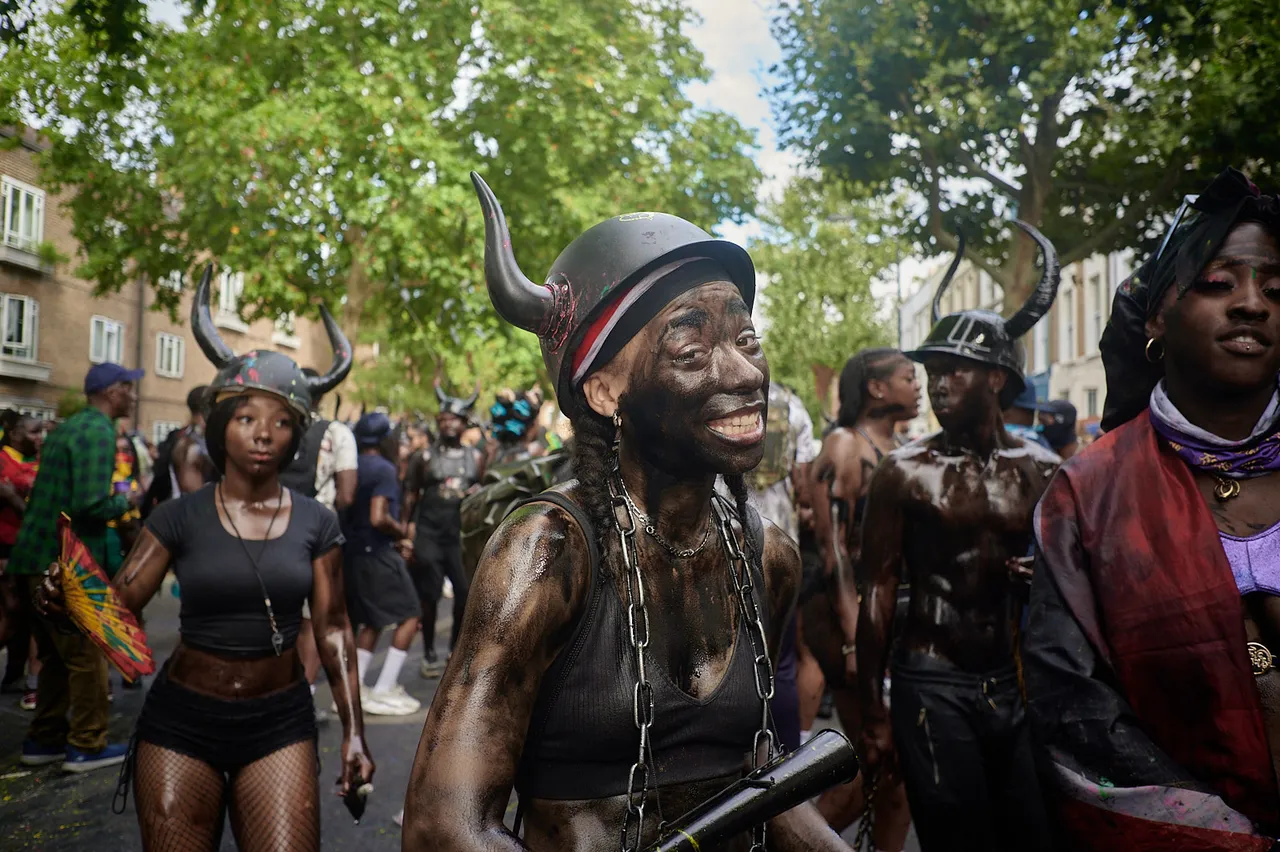
A woman walks towards the camera wearing a horned helmet, her skin glistening in the sun, a heavy chain falling across her chest. Around her, people in costumes and body paint fill the street. Someone carries a fan. Someone else looks directly towards the camera. The scene is loud even as a photograph, full of movement, colour, bodies and performance.
It is spectacular.
That word can make us uneasy when we talk about photographs of Black people. Spectacle has a long and troubling history. Black bodies have been displayed, exoticised and turned into objects of curiosity for audiences accustomed to looking from the outside. The problem is real.
But perhaps we have started asking the wrong question. The problem is not that Black life can be spectacular. It is that photography has too often assumed that spectacle gives it permission to interpret Black life from the outside.
Look at this photograph and the temptation is immediate. The horns become exotic. The body becomes provocative. The costumes become strange. The gathering becomes evidence of some unfamiliar culture that needs to be explained to someone who is not there.
The photograph can be accurate and still produce that distance.
Nothing in the frame has to change for its meaning to change. The people remain dressed as they are. The bodies remain visible. The street remains crowded. What changes is the position from which we look.
This is one of the reasons the idea of a Black gaze matters. It is not simply a matter of putting a Black photographer behind the camera, as though identity automatically produces a truthful image. Nor is it a promise that Black photographers will photograph Black life without spectacle.
It asks something more difficult: what does the person behind the camera understand about what they are seeing, and what does that understanding allow the photograph to retain?
A celebration can be visually overwhelming without being visually alien. A costume can be flamboyant without being exotic. A body can be displayed without being available for consumption. A crowd can be exuberant without being chaotic. These distinctions are easy to lose when photography has already decided what Blackness looks like.
For much of photography's history, Black bodies have been made visible through categories imposed upon them. The camera has looked for the primitive, the dangerous, the impoverished, the resilient, the sexual, the suffering. Even apparently sympathetic photographs can reproduce the same distance when the subject's significance is determined primarily by what the image means to the viewer.
This photograph resists that possibility because there is no obvious need to translate the scene into a problem.
The woman is not asking us to understand her hardship. She is not demonstrating resilience. She is not standing in for an entire community. She is participating in something that has its own visual language, its own pleasures and its own reasons for being.
That matters because representation is not the measure of Black photography.
A photograph does not become more truthful simply because it shows Black people positively. Nor does it become more problematic because the people pictured are flamboyant, sensual, theatrical or loud. The question is what kind of looking the photograph makes possible.
This is where the distinction between spectacle and spectacle from within becomes useful. Every culture has forms of performance, adornment and collective display. People dress up. People dance. People exaggerate themselves. People create occasions in which ordinary rules about appearance and behaviour can be suspended.
The camera does not have to flatten those moments into ordinariness in order to respect them.
That is important. There is a danger in responding to stereotypical images of Black life by searching only for quietness, intimacy and the everyday. We can end up creating another narrow visual expectation, one in which Blackness becomes acceptable only when it is presented softly.
That is not freedom from the gaze. It is another version of it.
The Black gaze should be allowed to contain contradiction. It can be intimate and spectacular, quiet and excessive, ordinary and theatrical. It can photograph a person sitting at a kitchen table and a person wearing horns in the street. Neither image has to explain Blackness.
The work is in learning how to look.
And that responsibility belongs to the viewer as much as the photographer. We bring histories to photographs. We bring expectations. We have learned that certain bodies mean certain things and that certain scenes deserve particular kinds of attention. Sometimes the most revealing thing in a photograph is not what the camera has shown us, but what we immediately assumed it meant.
Perhaps that is why this image feels important.
It does not ask us to look away from spectacle. It asks us to stay with it long enough to stop treating spectacle as explanation. The people in this photograph do not need to become less visible, less expressive or less extraordinary for us to see them properly. Maybe what needs to change is not the spectacle. Maybe it is the gaze we bring to it.


