What does a photograph leave out of Jamaica?
Jamaica may be small on a map, but its cultural reach is immense. What happens when a photograph turns that complexity into a gun, a performance or a single person?
“Wi likkle but wi tallawah” is a statement about scale. Jamaica may be small on a map, but its influence has travelled far beyond its shores, through music, language, fashion, spirituality, politics and the movement of its people.
Photography has often struggled with that kind of scale.
Jamaica can become surprisingly small inside a photograph. Violence becomes the country. Poverty becomes the place. Exoticism becomes the culture. A single image can be accurate and still reduce the world it describes.
The question, then, is not simply whether a photograph represents Jamaica correctly. It is what the photograph allows us to imagine exists beyond the frame.
Boogie's A Wah Do Dem offers a useful place to begin. In one photograph, a man lifts his shirt to reveal a handgun tucked into his waistband. His face is excluded. We see the weapon, his hands, his clothes, his belt. The gun becomes the organising fact of the image.
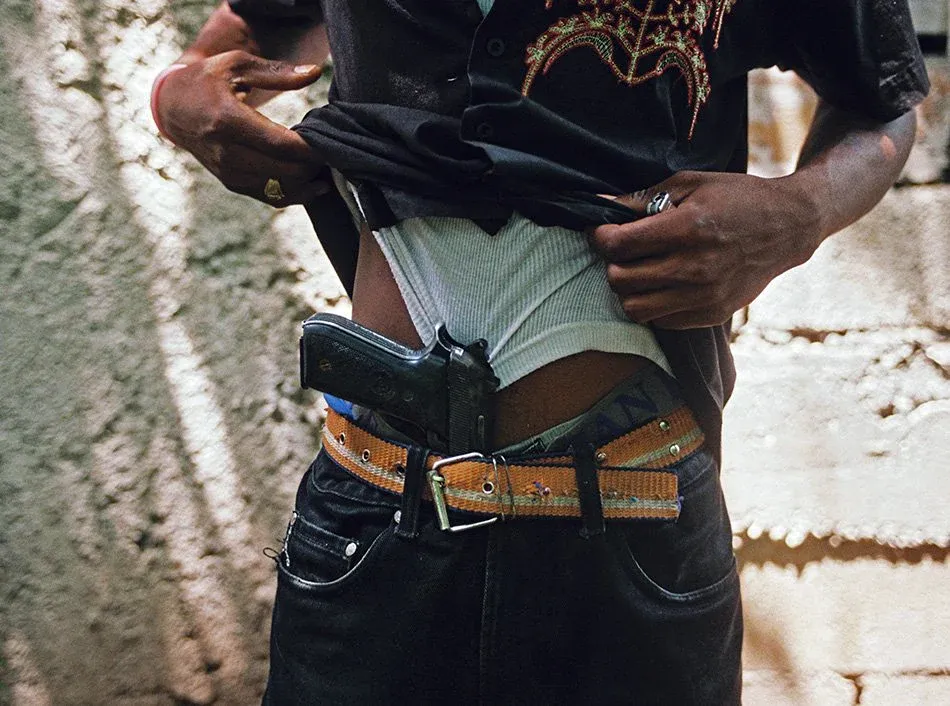
It is a photograph of something real. Jamaica has violence. But the photograph also demonstrates how quickly a real thing can become the thing.
Once the gun becomes the subject, the man becomes secondary. His history, relationships, humour, ambitions, fears and ordinary routines disappear. The photograph does not have to be false to produce a narrow truth. It only has to make one part of a life carry the weight of the whole.
This is one of photography's recurring problems. We often mistake what is most visible for what is most significant.
Lúa Ribeira's Noises in the Blood moves somewhere else. Its Jamaica is not organised around violence but around bodies, performance, transformation and visual invention.
In one photograph, a woman lies on a bed dressed in an elaborate black costume covered with jewellery, flowers and other ornamentation. A striking eye motif sits across her forehead. Beside her, another figure is almost completely hidden beneath white sheets. The domestic setting remains visible around them: bedding, rugs, furniture, the ordinary traces of a room.
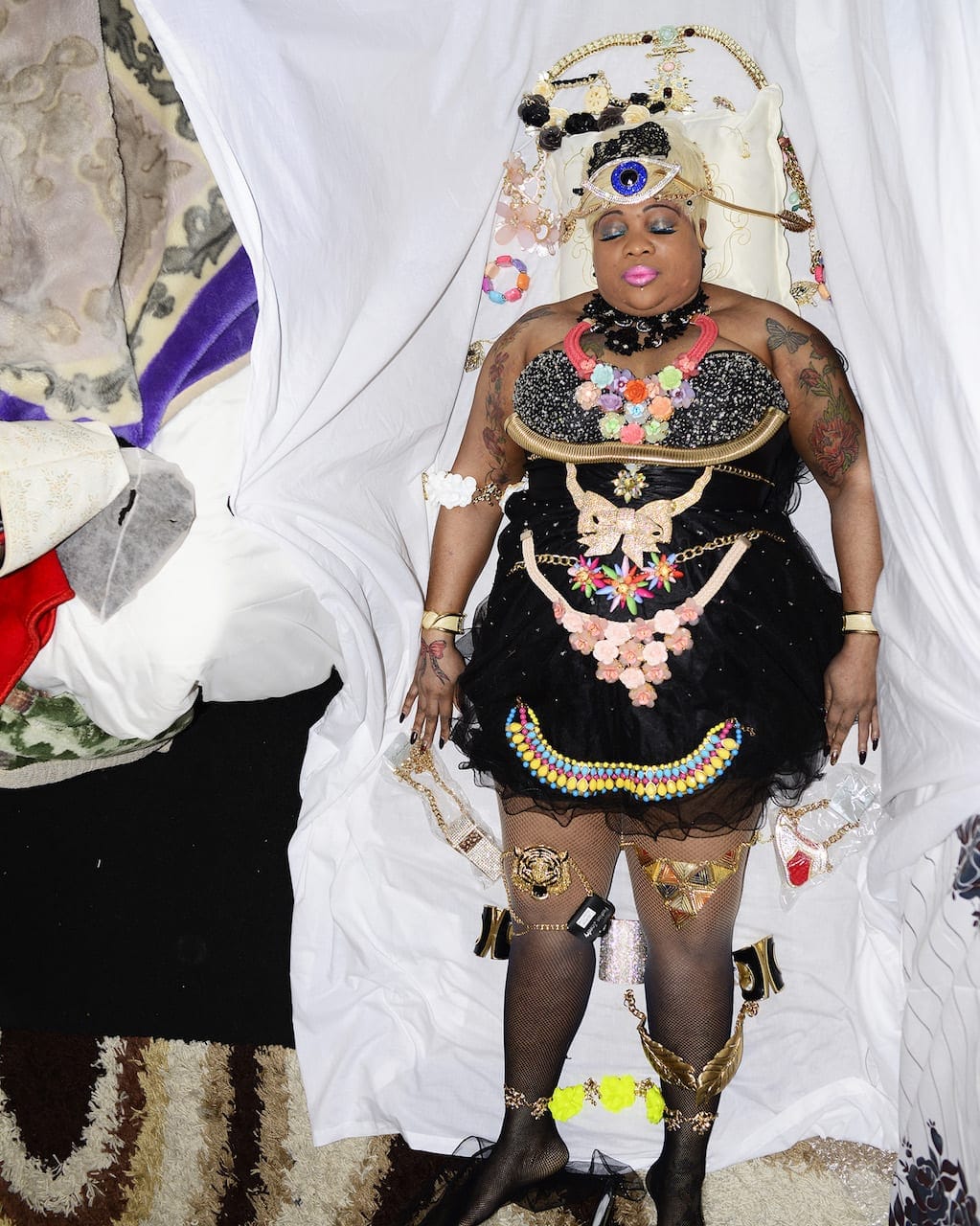
The photograph is visually overwhelming. It is theatrical, intimate and deliberately strange. The room becomes a stage, but it never stops being a room. That tension is important.
The image does not simply document Jamaica. It constructs an encounter with it through performance and transformation. It asks us to look at what people can make of their bodies, their surroundings and the visual languages available to them. But it also raises a harder question. What happens when culture becomes most visible when it becomes most visually striking?
The problem is not that performance is somehow less authentic than ordinary life. It may be one of the ways identity is expressed, negotiated and enjoyed. The problem is what happens when the viewer mistakes the spectacle for an explanation.
The woman is not reducible to her costume. The concealed figure is not simply a visual device. The room contains a life that the photograph cannot give us. The image can be imaginative and still leave much unknown.
Jamaica has not disappeared from the photograph. It has become one particular way of seeing Jamaica.
Andrew Jackson's From a Small Island approaches the problem differently. His photographs move through memory, migration, belonging and inheritance, allowing Jamaican identity to extend beyond geography.
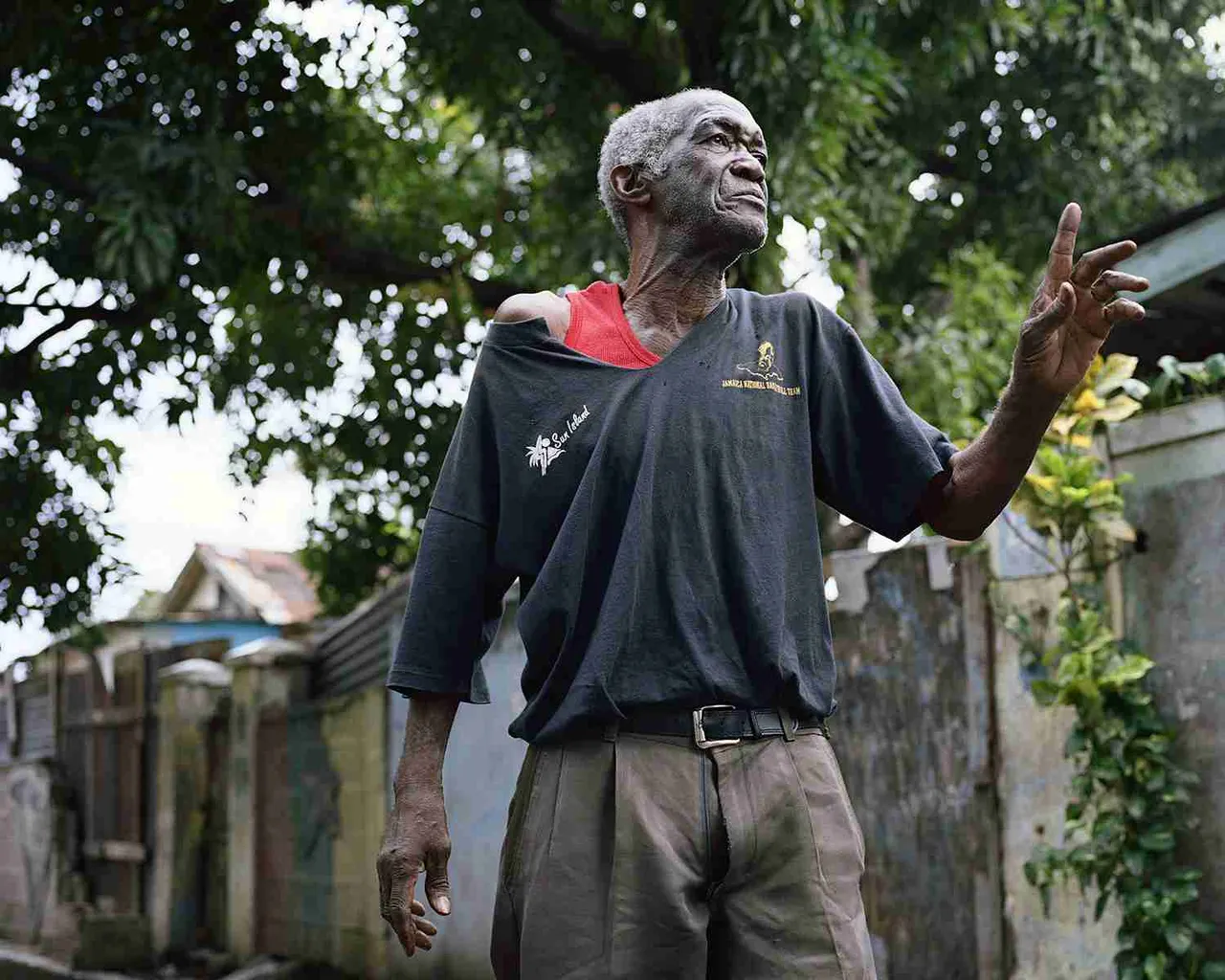
One photograph shows an older Jamaican man standing outdoors, his head turned upwards and one hand raised in gesture. Behind him are trees, houses and the textures of an everyday neighbourhood. He appears to be speaking or responding to something beyond the frame.
There is no obvious symbol to decode. The photograph does not ask us to solve Jamaica. It gives us a person.
That difference matters. The raised hand seems to point beyond the photograph, towards a conversation, a memory or a relationship that began before the shutter was released. We cannot know exactly what is happening, and the photograph does not pretend that we can.
Instead, it leaves room for a life beyond the frame.
This may be the more useful way to understand “Wi likkle but wi tallawah”. Tallawah is not simply a claim about Jamaica's cultural influence. It challenges the assumption that physical scale determines significance. The island's importance cannot be contained by its geography, just as a person's life cannot be contained by the most legible thing about them.
Photography has a tendency to compress.
It takes a complicated life and produces a single frame. It takes a culture and produces a visual language. It takes a place and gives us an image that can begin to stand in for the place itself. That compression is part of the medium's power, but it is also where its limitations become visible.
The issue is therefore not that photographers should avoid violence, performance or visual intensity. That would simply replace one narrow definition of Jamaica with another. Nor is it enough to photograph ordinary life as a corrective.
The deeper question is whether the photograph leaves enough room for complexity to survive its own framing. This is where the person behind the camera matters.
What has the photographer learned to notice? What do they recognise as significant? What assumptions enter the frame before the shutter is pressed? And what becomes difficult to see because the photograph has already decided what the viewer should look at?
A Black gaze does not guarantee that everything will be seen. But it can change the terms on which looking takes place, bringing histories, relationships and forms of knowledge that an outside gaze may overlook.
The strongest photographs of Jamaica may therefore be those that resist making the island completely explainable. A gun is part of Jamaica. A spectacular performance is part of Jamaica. An older man standing in his neighbourhood is part of Jamaica. None of them is Jamaica itself.
“Wi likkle but wi tallawah” asks us to understand that scale is not measured only by what can be seen. Perhaps photography needs the same lesson.
The frame may be small.The world beyond it is not.


