The photograph that changed how I looked at photographs
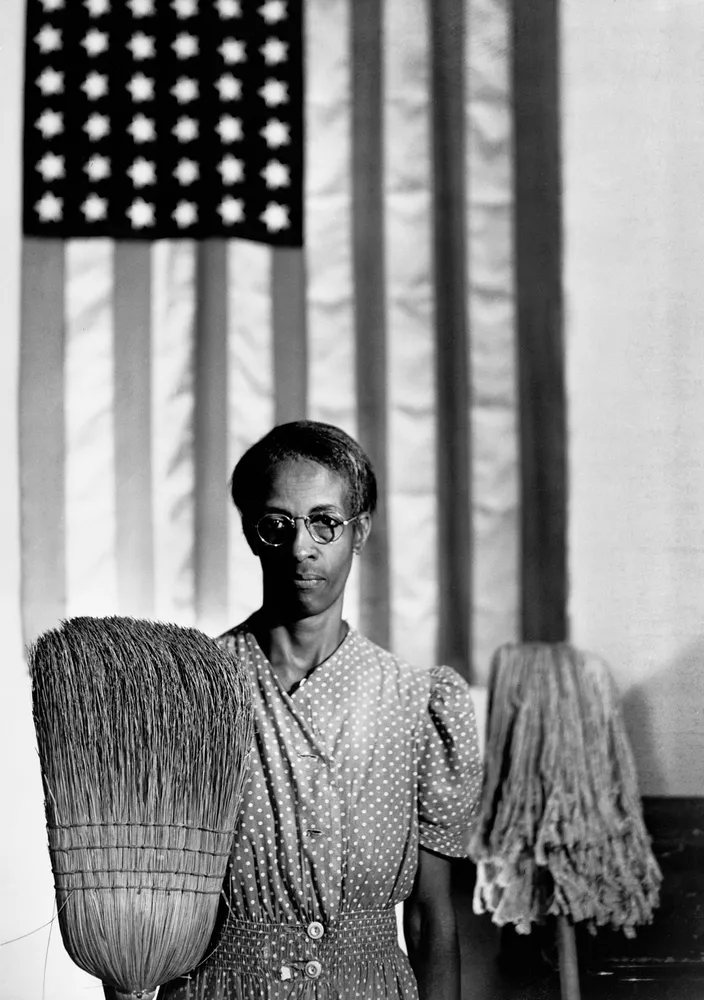
A woman stands in front of an American flag holding a mop and a broom.
At first glance, the photograph appears straightforward. The woman looks directly at the camera. The flag fills the background. The cleaning tools are held upright like ceremonial objects. Everything is carefully arranged. Nothing appears accidental.
The photograph is American Gothic, Washington, D.C. (1942), Gordon Parks's portrait of Ella Watson, a Black government worker he met while working for the Farm Security Administration. The image has become one of the most recognised photographs of the twentieth century, not because it records a dramatic event, but because it reveals how photography creates meaning.
The mop, the broom, the flag, the expression on Watson's face. Together they form an argument about labour, citizenship, dignity, and exclusion. Parks was not simply showing viewers what Ella Watson looked like. He was asking them to think about the country in which she lived.
The first time I encountered the photograph, I realised that photography is never just about appearances. A photograph can describe a person, but it can also describe a society. It can reveal relationships between people, institutions, histories, and ideas.
That lesson runs through Gordon Parks's work.
Parks is often remembered as a pioneering Black photographer, filmmaker, writer, and composer. Those achievements matter. Yet what continues to draw me to his work is the way it helps me understand photography itself. His photographs demonstrate how images can reveal power, preserve memory, challenge assumptions, and deepen our understanding of other people's lives.
These are ten lessons Gordon Parks has taught me about photography.
1. Photography is never neutral
One of the myths photography continues to tell about itself is that cameras simply record reality. Parks's photographs remind us that every image involves choices.
In American Gothic, Parks could have photographed Ella Watson at her desk, walking through a corridor, or speaking with colleagues. Instead, he placed her in front of an American flag and handed her the tools of her labour. The resulting image transformed a portrait into a social critique.
The lesson is not that photographers should always make political photographs. The lesson is that photographs are always shaped by decisions. Framing, timing, composition, distance, and context all influence meaning. Every photograph reflects a point of view, whether the photographer acknowledges it or not.
Parks teaches us that neutrality is often another name for unexamined choices.
2. The photograph begins before the shutter is pressed
Before Parks photographed Ella Watson, he spent time listening to her.
Watson shared stories about racism, discrimination, work, and daily life in Washington. The photograph emerged from a relationship rather than an encounter. Parks understood that meaningful photographs often begin with conversation.
This lesson becomes even clearer throughout his career. The strongest documentary photographs rarely come from photographers arriving, taking pictures, and leaving. They emerge through trust, curiosity, and attention.
Photography starts long before the camera reaches your eye. It begins with the willingness to understand another person.
3. A photograph can reveal a system
Many documentary photographs focus on events. Parks often focused on structures.
His photographs from the Segregation Story series show children, families, churchgoers, workers, and ordinary moments across the American South. There are no dramatic confrontations in many of the images. Instead, we see the quiet architecture of segregation.
Separate entrances. Separate waiting rooms. Separate schools.
Parks understood that injustice is often embedded within everyday life. Rather than photographing isolated incidents, he photographed the conditions that made those incidents possible.
Photography becomes more powerful when it helps us see systems rather than symptoms.
4. Ordinary life is never ordinary
Photography has often treated Black life as visible only when something extraordinary happens. Protest. Crisis. Violence. Celebrity. Parks looked elsewhere.
Across his work we encounter children playing, families eating, couples talking, neighbours gathering, people travelling to work, and communities worshipping together. These photographs may appear unremarkable at first, yet they reveal something essential.
The ordinary is where people actually live.
Parks understood that everyday life contains its own forms of beauty, struggle, joy, and meaning. By taking ordinary moments seriously, he challenged photography's tendency to define Black life through exception rather than experience.
5. Beauty and truth do not have to compete
Some photographers treat beauty as a distraction from reality. Others treat aesthetics as an end in themselves. Parks refused that choice.
His photographs are often beautifully composed. Light falls carefully across faces. Shapes echo across the frame. Tonal relationships guide the eye through an image. Yet that beauty never feels decorative.
Instead, beauty becomes a way of encouraging attention.
The photographs draw us in through their visual richness and then ask us to remain with difficult realities. Parks understood that aesthetics and ethics are not opposites. Beauty can deepen our engagement with truth rather than diminish it.
6. The decisive moment is not the only moment
Photography often celebrates speed. The photographer reacts. The shutter clicks. The moment is captured. Many of Parks's photographs operate differently.
Their power comes not from split second timing but from observation, patience, and accumulated understanding. His photographs often feel considered rather than hunted. They invite viewers to spend time within an image rather than admire a photographer's reflexes.
This challenges one of photography's most enduring assumptions. Not every meaningful photograph depends upon a decisive moment. Some photographs gain their power through atmosphere, relationship, and reflection.
Parks reminds us that seeing slowly can reveal things speed cannot.
7. Representation is about complexity
One of Parks's most famous photo essays followed Leonard "Red" Jackson, a teenage gang leader in Harlem.
The easy version of the story already existed. Newspapers had spent years portraying young Black men as threats, problems, and statistics. Parks offered something different.
His photographs show Jackson with friends, family members, girlfriends, and neighbours. We see confidence, vulnerability, loneliness, pride, uncertainty, and affection. The resulting portrait refuses simplification.
Photography becomes more honest when people are allowed to remain complicated.
Parks teaches us that representation is not simply about making people visible. It is about allowing them to exist beyond stereotypes.
8. Photographs can make the invisible visible
Parks's work inspired by Ralph Ellison's Invisible Man remains some of the most inventive photography of his career.
The photographs move beyond straightforward documentation. Light bulbs fill rooms. Shadows stretch across walls. Symbolism becomes central to the storytelling.
Rather than illustrating the novel literally, Parks used photography to explore ideas about visibility, identity, and belonging.
These images expand our understanding of what documentary photography can be. Facts matter, but facts alone are not always enough. Sometimes photography helps us visualise experiences that cannot be directly photographed.
The invisible can still leave traces within an image.
9. Photographs become archives of feeling
Historical photographs often tell us what happened.
The strongest photographs tell us something more difficult. They tell us what it felt like.
Looking at Parks's photographs today, we learn about segregation, poverty, migration, and inequality. Yet we also encounter tenderness, frustration, pride, faith, boredom, hope, and resilience.
The photographs preserve emotional realities alongside historical ones.
This is one reason archives matter. They do more than record information. They preserve ways of seeing and ways of feeling. Parks's photographs continue to teach us about the past because they remain alive with human experience.
10. The most important thing in a photograph is the person
Across decades of work, countless assignments, and multiple creative disciplines, one principle remained consistent.
Parks never lost sight of people.
Whether photographing Ella Watson, Red Jackson, children in Harlem, or families in the American South, he approached people as human beings rather than symbols. His photographs are attentive to individuality even when addressing larger social questions.
This may be the most important lesson of all.
Photography can become obsessed with technique, equipment, aesthetics, and recognition. Parks reminds us that photographs ultimately begin with people. The camera matters. The image matters. The person matters most.
Learning to see with Gordon Parks
What Gordon Parks ultimately taught me is that photography is not simply a way of looking at people. It is a way of understanding relationships between people, history, power, memory, and place.
His photographs reveal that cameras do more than record the world. They help shape how the world is understood. Through portraits, photo essays, and visual storytelling, Parks showed that photography can challenge assumptions, preserve experience, and expand our capacity for empathy.
More than twenty years after his death, his work continues to offer one of photography's most valuable lessons. Before asking what a photograph shows, we should ask what it helps us understand.
That question sits at the heart of Gordon Parks's photography. It remains one of the most important questions photography can ask.